|
|

|
Contact us for FREE HOME EVALUATION.

|
|
|
Contact us for FREE HOME EVALUATION.

Sales & Listings:
Total Sales: 46 homes (unchanged YoY)
New Listings: 71 (⬆ 51% YoY)
Inventory: 101 active listings (⬆ 216% YoY)
Sales-to-New Listings Ratio: 0.65 — indicating a balanced to buyer’s market
Months of Supply: 2.20 — a slight increase, still below balanced market threshold
Benchmark Prices (YoY):
Total Residential: $623,300 (⬇ 4.2%)
Detached: $810,200 (⬇ 0.6%)
Semi-Detached: $526,800 (⬆ 1.7%)
Row House: $460,700 (⬆ 1.1%)
Apartment: $355,000 (⬇ 2.8%)
Average Days on Market: 35
Sale-to-List Price Ratio: 98.0%
Inventory surge (+216%) is giving buyers more options and reducing upward price pressure.
Detached homes remain the dominant product, but higher interest rates and affordability challenges are fueling interest in row houses and apartments.
Apartments saw the steepest year-over-year price drop, possibly due to increased competition and a higher supply in this segment.

With growing inventory and slight price softening, Auburn Bay offers strategic buying opportunities:
First-time buyers can enter via apartments or row homes
Investors may benefit from rental demand driven by lake access, amenities, and proximity to Seton Urban District and South Health Campus
Move-up buyers can find upgraded detached homes at relatively stable prices
If current trends continue, we may see stable pricing but longer selling times as buyers gain more leverage. However, the enduring popularity of lake communities like Auburn Bay should support long-term value.
Contact us for a Free Home Evaluation.

The Canada Mortgage and Housing Corporation (CMHC) unveiled the results of its fifth cycle of the Social and Affordable Housing Survey – Rental Structures (SAHS‑RS), revealing key trends in Canada’s non‑market rental housing sector on July 22, 2025.
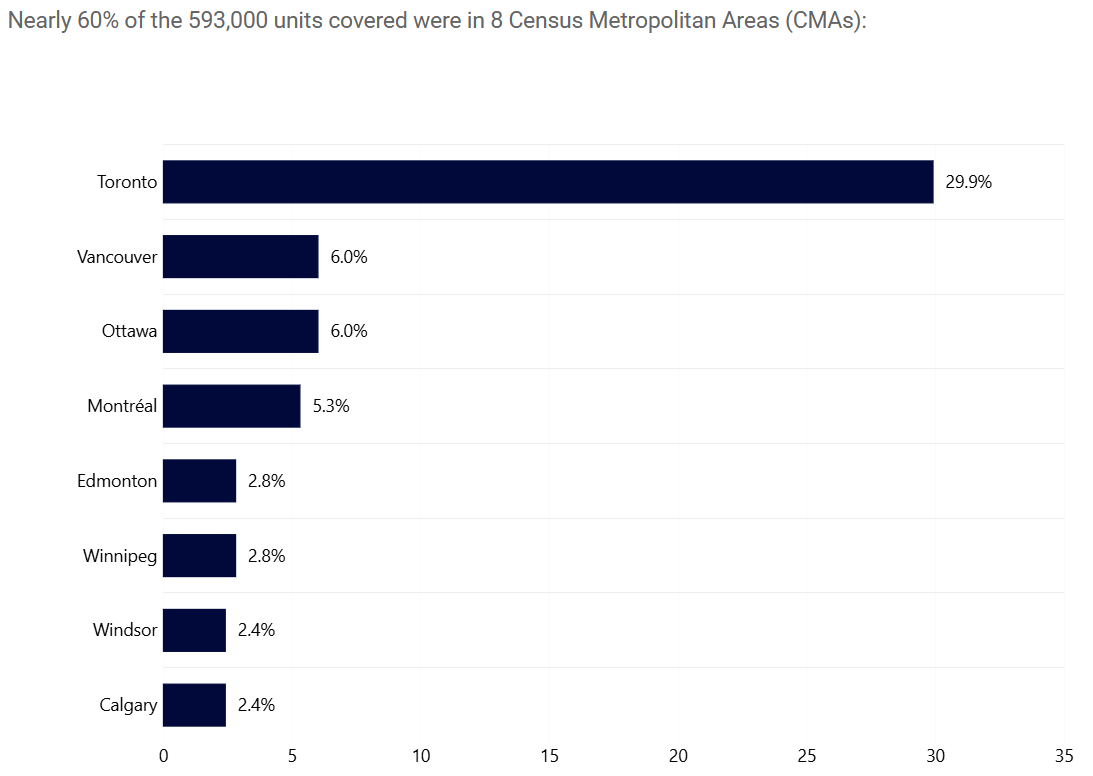
The survey covers nearly 593,000 units across Canada, with the highest share located in Ontario (56.1%), followed by British Columbia (11.5%), Quebec (9.4%), Alberta (6.7%), and other provinces and territories. Almost 60% of these units are concentrated in eight major Census Metropolitan Areas, including Toronto (30%), Vancouver (6%), Montréal (5.3%), Edmonton, Winnipeg, Calgary, Windsor, Victoria, Kitchener–Waterloo, and St. Catharines–Niagara .
Response rates inched up from 66% to 76% nationally, as CMHC expanded administrative data coverage and refined its sampling—though Quebec remains partially excluded due to missing data from structures managed by the Société d'habitation du Québec (SHQ).
The survey breaks down unit management as follows:
53% government-run (federal, provincial, municipal)
26% non‑profit organizations
7% cooperatives
17% private entities or joint partnerships
This reflects a longstanding dominance of government and non‑profit providers in Canada’s social housing landscape.
In terms of funding sources:
Federal government: 17%
Provincial/Territorial: 23%
Municipal: 30%
Other organizations or mixed sources: 11%
No formal funding agreement: 19%—this was particularly acute in the Northwest Territories (no agreements), contrasting with only 1% in New Brunswick and 5% in Quebec lacking agreements.
For operational deficit funding:
Federal: 1.5%
Provincial/Territorial: 24%
Municipal: 32.4%
Other or mixed: 5.6%
No coverage: 36.5%—varied by region. For example, 95% of Saskatchewan’s units lacked operational deficit funding, compared to just 5% in Manitoba.
CMHC asked providers what populations they were mandated to serve:
Seniors: 33%
Families with children: 25%
Single men or women: ~11% each
Persons with physical or mental disabilities: ~4% each
Single-person tenants were less common in Saskatchewan and Alberta (1–5%), but represented 15–25% of the clientele in other provinces.
In terms of service providers:
56% of clientele served by government bodies
29% served by non‑profits
Services for veterans, persons with disabilities, First Nations, Métis, Inuit, immigrants, refugees, victims of domestic violence, and formerly homeless individuals were twice as likely to be provided by non‑profits compared with governments.
The sector’s housing stock is aging:
15% built after 1995
35% built between 1980 and 1995
49% built before 1980
In Quebec and the three territories, over one‑third of units were built post‑2003. In contrast, Ontario, the Prairies and Atlantic provinces have 65–90% of stock built before 1987.
Regarding building condition:
43.5% of units rated as excellent/good
19% rated average
37.3% rated fair or poor — a pattern largely consistent with the 2023 survey, except Saskatchewan saw a sharp shift from average to fair condition (increasing fair-rated units from ~31% to ~79%).
Newer buildings fare better: 77% of units built after 2003 were in excellent or good condition, compared to 38% of older units (pre-2003) receiving that rating.
These results show a non‑market housing sector that is heavily government-supported but aging, with significant regional disparities, especially in funding coverage and building condition. The rising number of units in fair or poor condition—particularly among older stock—highlights the critical need for renovation and investment. The unequal distribution of operational deficit funding and the significant share of units serving marginalized populations underscore ongoing equity challenges for social housing policy in Canada.
(How much is your home worth? Contact us for a Free Home Evaluation.)

For the second time this year, the Canadian Real Estate Association has downgraded its forecast for home sales in 2025, even as it says a turnaround could be looming following increased activity in June.
Sammy Hudes, The Canadian Press Jul 15, 2025 1:12 PM
For the second time this year, the Canadian Real Estate Association has downgraded its forecast for home sales in 2025, even as it says a turnaround could be looming following increased activity in June.
The association reported that the number of homes changing hands across the country in June rose 3.5 per cent compared with a year ago. Canadian home sales last month also increased 2.8 per cent compared with May on a seasonally adjusted basis.
In its outlook released Tuesday, CREA said it now expects a total of 469,503 residential properties to be sold this year, a three per cent decline from 2024. In April, the association forecast the number of home sales for 2025 to remain essentially unchanged from last year, which itself marked a steep cut from its January forecast of an 8.6 per cent year-over-year increase.
The national average home price is forecast to fall 1.7 per cent on an annual basis to $677,368 in 2025, which would be around $10,000 lower than predicted in April.
CREA senior economist Shaun Cathcart said that despite a "chaotic start to the year," the latest data suggests the housing market rebound originally forecast for this year — before it was upended by the Canada-U.S. trade war — may have "only been delayed by a few months."
“At the national level, June was pretty close to a carbon copy of May," said Cathcart in a press release, cautioning "we’re not out of the woods yet" given U.S. President Donald Trump's latest 35 per cent tariff threat.
The association said the tariff-related uncertainty that drove so many buyers back to the sidelines earlier this year ended up taking a larger bite out of activity in B.C., Alberta and Ontario than was expected three months ago, but "the good news is markets appear to be entering their long-expected recovery phase, fuelled by pent-up demand, lower interest rates, and an economy that is expected to avoid worst-case tariff scenarios."
“Most housing markets continued to turn a corner in June, although market conditions still vary considerably depending on where you are in Canada,” said CREA chair Valérie Paquin.
“If the spring market was mostly held back by economic uncertainty, barring any further big shocks, that delayed activity could very likely surface this summer and into the fall."
CREA said it now forecasts national home sales in 2026 to improve by 6.3 per cent to 499,081. That would put activity back on track with what was expected in its April forecast, when it predicted a 2.9 per cent gain in sales next year.
The national average home price is expected to increase three per cent from 2025 to $697,929 next year.
Meanwhile, the national average sale price fell 1.3 per cent in June compared with a year earlier to $691,643.
There were 47,871 home sales recorded last month, up from 46,237 in June 2024. The association said the recovery in sales activity over the past two months was led overwhelmingly by the Greater Toronto Area.
Still, activity remains slower than usual, said Cameron Forbes, a Toronto-area broker and general manager at Re/Max Realtron Realty Inc.

"The uncertainty of the Trump tariffs and the impact on, certainly in Ontario, the manufacturing context and everything, still has a lot of buyers on the sidelines that probably shouldn't be," said Forbes in an interview.
"It's still a market where I think buyers are unfortunately a bit uncertain. Many of them who have jobs, who have security of those jobs, who have equity in homes, that would be a great time for them to make a trade to a preferred location or a larger home for their family, but they are looking at the headlines and seeing the uncertainty related to tariffs."
The number of newly listed properties throughout the country was down 2.9 per cent month-over-month from May. A total of 206,435 properties were listed for sale by the end of the month, up 11.4 per cent from a year earlier and just one per cent below the long-term average for this time of the year.
"June's sales performance came in broadly as expected, with Canadian transactions continuing their gradual recovery from their early-year depths," said TD economist Marc Ercolao in a note.
"We expect home sales will continue to rise in the second half of the year as pent-up demand continues to trickle into the market. That said, the sales level should remain subdued as economic uncertainty remains elevated, especially with Canada facing new tariff threats."
BMO senior economist Robert Kavcic said there are three major factors still holding back the housing market, including a "sluggish" job market being aggravated by the trade war. With the Bank of Canada holding its key policy rate steady, he said mortgage rates of around four per cent are also "not low enough to improve the affordability calculus in a demand-sparking way."
"And, market psychology now appears bearish," said Kavcic in a note.
"Just as expectations of higher prices drove accelerating gains on the way up, the understanding that prices are falling is holding back buyers on the way down in some locations."
Forbes added that much is riding on the outcome of ongoing trade negotiations between Canada and the U.S., which currently hold an Aug. 1 deadline. Reaching a compromise could prompt buyers to return, leading to a more "healthy market," he said.
But failing to reach an agreement on time would mean further uncertainty in the housing market, he said.
"If that's the case, then we'll continue to have fewer sales for at least the next three or four months until the impacts of whatever comes to fruition are better known."
Contact us for a Free Home Evaluation.

Higher turnover rents in several major rental markets have decreased tenant mobility, leading to longer average tenancy periods and "more substantial" rent increases when tenants do move, says CMHC.
Canada's housing agency says advertised rents in some major cities are easing due to factors such as increased supply and slower immigration, but renters are still not feeling relief.
In its mid-year rental market update released Tuesday, Canada Mortgage and Housing Corp. said average asking rents for a two-bedroom purpose-built apartment were down year-over-year in four of seven markets.
Vancouver led the way with a 4.9 per cent decrease in the first quarter of 2025, followed by drops of 4.2 per cent in Halifax, 3.7 per cent in Toronto and 3.5 per cent in Calgary. Average asking rents grew 3.9 per cent in Edmonton, 2.1 per cent in Ottawa and two per cent in Montreal, compared with the first quarter of 2024.
Landlords reported that vacant units are taking longer to lease, CMHC said, especially for new purpose-built rental units in Toronto, Vancouver and Calgary, where they face competition from well-supplied secondary rentals such as condominium units and single-family homes.
"Purpose-built rental operators are responding to market conditions by offering incentives to new tenants such as one month of free rent, moving allowances and signing bonuses," the report said, adding some landlords anticipate they may need to lower rents over the next couple of years.
The agency said rents for occupied units are continuing to rise but at a slower pace than a year ago. It said higher turnover rents in several major rental markets have decreased tenant mobility, leading to longer average tenancy periods and "more substantial" rent increases when tenants do move.
In 2024, the gap in rental prices between vacant and occupied two-bedroom units reached 44 per cent in Toronto, the highest among major cities, while Edmonton had the smallest gap at roughly five per cent.
Vacancy rates are expected to rise in most major cities this year amid slower population growth and sluggish job markets, CMHC said.
"As demand struggles to keep pace with new supply, the market will remain in a period of adjustment. This is particularly true in Ontario due to lowered international migration targets, especially in areas near post-secondary institutions," the report stated.
"While the market may have abundant supply in the short-term, there is still a need to maintain momentum in new rental supply to meet the needs of projected future population growth and to achieve better affordability outcomes for existing households."
Despite downward pressure on rent prices, CMHC said affordability has still worsened over time as rent-to-income ratios have steadily risen since 2020, especially in regions like Vancouver and Toronto where turnover rents are driving increases.
A separate report released Tuesday outlined similar trends across the national rental market last month.
The latest monthly report from Rentals.ca and Urbanation said asking rents for all residential properties in Canada fell 2.7 per cent year-over-year in June to $2,125, marking the ninth consecutive month of annual rent decreases.
Despite the drop, average asking rents remained 11.9 per cent above levels from three years ago and 4.1 per cent higher than two years ago, "underscoring the long-term inflationary pressure in the rental market," the report said.
Purpose-built apartment asking rents fell 1.1 per cent from a year ago to an average of $2,098, while asking rents for condos dropped 4.9 per cent to $2,207. Rents within houses and town homes fell 6.6 per cent to $2,178.
“Rent decreases at the national level have been mild so far, with the biggest declines mainly seen in the largest and most expensive cities," Urbanation president Shaun Hildebrand said in a news release.
"However, it appears that the softening in rents has begun to spread throughout most parts of the country.”
B.C. and Alberta recorded the largest decreases in June, with asking rents falling 3.1 per cent year-over-year in each province to an average of $2,472 in B.C. and $1,741 in Alberta.
That was followed by Ontario's 2.3 per cent decrease to $2,329, Manitoba's 1.3 per cent decrease to $1,625 and Quebec's 0.9 per cent decrease to $1,960. Nova Scotia's average asking rent ticked 0.1 per cent lower to $2,268, while Saskatchewan was the only province to record year-over-year growth, at 4.2 per cent, to an average of $1,396.
This report by The Canadian Press was first published July 8, 2025.
Sammy Hudes, The Canadian Press

|
|
|
|
|
|
|
|

Sales: 48 (-14% vs. Q1’s 56). New listings: 76. S-to-N ratio: 63.16% — still a clear sellers’ market.
Average inventory: 20 homes. Months of supply: 1.27 (tight). Median DOM: 18 days.
Benchmark price (all residential): $722,100 (+0.18% QoQ, +0.38% YoY).
Sales mix: Detached = 89.4% of sales; Row/Townhomes ≈ 10%; Apartments = 0% (virtually no condo stock in the quarter).
Prevalence: Nearly 9 in 10 sales were detached, underscoring the lake-community’s single-family identity.
Pricing:
Two-storey benchmark: $764,267
Bungalow/one-storey benchmark: $718,200
Tempo: At 1.27 MOS and 18 DOM, well-priced homes faced multiple-showing weekends and quick offers.
Buyer profile: Move-up families targeting bedroom count, finished basements, and proximity to Mountain Park School and the Beach Club.
Share of sales: ~10% with row benchmark at $425,833; thin inventory means price discovery can be jumpy from one sale to the next.
Buyer profile: Downsizers and first-timers seeking lake-community lifestyle at a lower entry price.
Activity: No apartment sales recorded in Q2; condo options remain scarce in McKenzie Lake proper.
Buyer redirect: Condo shoppers often look to nearby lake-adjacent SE communities when they need this format.
Sellers’ market holds: A 63% sales-to-new-listings ratio with ~1.3 months of supply kept leverage with sellers; small QoQ price gains and sub-3-week median DOM confirm demand resilience.
Seasonality vs. selection: Sales dipped from Q1, but new listings (76) gave buyers slightly more selection—important for move-up purchasers targeting two-storeys near schools and the lake amenities.
What could shift Q3: Any late-summer listing wave could ease bidding pressure; otherwise expect continued stability around the $720k–$770k band for typical family homes, with renovated lake-access properties clearing above.
Family two-storey (most common): $764,267 benchmark. Updated kitchens, A/C, and landscaped yards near school walk-zones drew fastest activity.
Bungalow (downsizer favourite): $718,200 benchmark. Single-level living with modernized interiors remained competitive given limited supply.
Row/Townhome: $425,833 benchmark. When a good one lists, expect swift interest from budget-sensitive buyers.
(Benchmarks are reference points; individual homes trade above/below based on renovation level, lake access, lot, and garage size.)
Beach Club & programs: The McKenzie Lake Residents Association (MLRA) continued spring-to-summer operations and programming at 16199 McKenzie Lake Way SE (Beach Club Hall, outdoor amenities, rentals).
Signature Q2 events:
Father’s Day Fishing Derby — June 15, 2025 (family angling & prizes).
Summer Food Truck Nights, Family Fun Day, Movie in the Park, Summer Send-Off (seasonal community gatherings).
Community Association programming: The McKenzie Lake Community Association ran year-round programs (incl. tots drop-in Sep–Jun) and before/after school care for McKenzie Lake School & St. John Henry Newman (K–5).
Newsletter notes: MyCalgary’s community newsletter reiterates MLRA amenities (tennis, basketball, beach volleyball, toboggan hill) and rental availability of the Beach Club facilities.
Public (CBE):
McKenzie Lake School — K–5; ~560 students; traditional calendar.
Mountain Park School — Grades 5–9; 312 Mt. Douglas Close SE; 403-777-6442.
Catholic (CCSD):
St. John Henry Newman School — K–9; 16201 McKenzie Lake Blvd SE.
Transit: Calgary Transit provides school express routes that many students use for daily commutes.
For sellers
Price tightly off the latest comps for your subtype (two-storey vs bungalow) and launch with complete pre-inspection + professional media; with ~18 DOM medians, your first two weekends matter most.
Consider pre-listing touch-ups that resonate locally: A/C installation, deck refresh, and low-maintenance landscaping for summer showings.
For buyers
Get financing finalized and be “offer-ready” for renovated two-storeys; at ~1.3 MOS, desirable listings don’t linger.
If you’re price-anchored under benchmark, watch the row/townhome segment and be prepared to move quickly when one appears.
Inventory drift: Any late-summer listing bump could nudge MOS toward balance; otherwise, expect steady pricing with slight upward bias in turnkey family homes.
Community draw: Ongoing MLRA events and Beach Club seasonality keep foot traffic high—often translating into stronger weekend showing volumes.
(How much is your home worth? Contact us for a Free Home Evaluation.)

Rangeview, Calgary’s first garden-to-table community, continued to show strong growth through the second quarter of 2025. The mix of detached, semi-detached, and row homes is appealing to a wide range of buyers, from young families to move-up purchasers, keeping demand healthy.
Sales Activity: Q2 posted steady transaction volumes as more new listings entered the market compared to Q1, giving buyers modestly more choice.
Pricing Trend: Home values remained resilient, with modest quarterly increases supported by strong demand for detached homes and stable affordability in townhomes.
Market Balance: Months of supply hovered near 2 months, reflecting a slightly constrained but more balanced market compared to early 2025. Average days on market stayed under 40 days, showing continued buyer urgency.
Benchmark Price: Mid-to-high $700,000s.
Market Notes: Remain the most in-demand segment, especially front-garage homes and those backing onto green space. Buyers prioritize space and proximity to garden lots and pathways.
Trend: Low supply continues to drive competition, keeping prices trending upward.
Benchmark Price: Around $580,000–$600,000.
Market Notes: Attract young families entering the market. Stable price growth, with most homes selling close to list price.
Trend: Balanced performance—steady sales volume but slightly longer days on market than detached homes.
Benchmark Price: Approximately $450,000–$480,000.
Market Notes: Affordable entry option for first-time buyers. Strong investor interest due to rental potential and proximity to future commercial areas.
Trend: Longer average days on market (~45–50 days) compared to detached, but pricing remains steady.
Benchmark Price: Low-to-mid $300,000s.
Market Notes: Limited but growing presence in Rangeview as new multi-family projects begin to develop. Ideal for downsizers or young professionals seeking low-maintenance living.
Trend: Small but steadily expanding segment, with demand tied to affordability pressures.
Commercial Growth: Early phases of retail and dining amenities are under development, with residents anticipating a small commercial hub by late 2025.
Designated Schools: Currently served by nearby communities, including Joane Cardinal-Schubert High School (Seton) and Cranston Elementary.
Future Plans: Land is allocated for future school development within Rangeview, anticipated to serve K–9 students as the population grows.
Nearby Options: Families also benefit from Catholic schools in Cranston and Auburn Bay.
Rangeview Garden Workshops: Seasonal events hosted for residents, teaching urban gardening, composting, and cooking with locally grown produce.
Canada Day Activities: Families gathered in the central park area for children’s games and evening celebrations.
Neighbourhood Nights: Weekly summer outdoor movie screenings and potluck dinners strengthened community ties.
Rangeview is establishing itself as one of southeast Calgary’s most unique lifestyle-focused communities. The emphasis on agriculture and sustainability continues to attract buyers seeking more than just a home, but a community experience. Detached homes remain the strongest-performing segment, but townhomes and duplexes provide key entry points for younger families and investors.
Market momentum is expected to stay strong into Q3 2025, with detached prices leading growth and multi-family development slowly expanding options for buyers.
(How much is your home worth? Contact us for a Free Home Evaluation.)

Inventory levels in June continued to rise, both over last month’s and last year’s levels. By the end of the month, inventory reached 6,941 units, returning to levels reported in 2021, or prior to the surge in population growth. While sales have remained consistent with long-term trends despite a decline from recent months, higher levels of new listings compared to sales have contributed to the inventory gain.
All property types have reported gains in inventory, but both row and apartment style homes reported inventory levels over 30 per cent higher than long-term trends, while supply for detached and semi-detached units are only slightly higher than typical levels.
“Supply has improved across rental, resale and new home markets, allowing for more choice for those considering their housing options,” said Ann-Marie Lurie, Chief Economist at CREB®. “The additional choice combined with no further declines in lending rates, persistent uncertainty and concerns of price adjustments is keeping many potential purchasers on the sidelines. This is weighing on home prices, especially for apartment and row style homes.”
The unadjusted benchmark price was $586,200 in June, lower than last month and over three per cent lower than last year. Much of the citywide decline was driven by apartment and row style homes, which are over three per cent lower than last year. Meanwhile, detached prices have remained relatively stable and semi-detached homes are still slightly higher than last year.
The steeper price declines for apartment and row style homes are reflective of those segments shifting toward a market that favours the buyer with nearly four months of supply. Meanwhile conditions are relatively balanced for detached and semi-detached homes. Overall conditions in Calgary have changed, but not enough to erase the significant growth in prices that have occurred over the past four years.

Sales in June were 1,194 units, six per cent lower than both last year and last month's activity. Sales activity did vary depending on location and price range, with declines in resale sales mostly for higher priced homes that likely face more competition from new homes. On a location basis, the steepest declines in sales occurred in the City Centre and the North East at over 20 per cent, while year-over-year gains were reported in the West, and South East districts.
While sales did vary, inventories and new listings improved across most price ranges and districts in the city. However, it is only the North East district that is experiencing conditions that favour the buyer, causing prices to decline by four per cent compared to last June. As of June, the unadjusted benchmark price in Calgary was $764,300, less than one per cent lower than both last month and last year’s price.
Sales activity continued to slow this month, contributing to the year-to-date decline of nearly 12 per cent. At the same time new listings have generally been rising compared to last year, supporting inventory gains and a shift to balanced conditions. As of June, the months of supply was 2.6 months, a significant improvement over the tight conditions reported last year.
Additional supply choice has slowed the pace of price growth for semi-detached homes. As of June, the benchmark price in the city was $696,400, similar to last month, and over one per cent higher than last June. Price movements did range by district, as homes in the City Centre are over three per cent higher than last year and at record high levels, while prices in the North, North East, and East districts are all over two per cent lower than last year and three per cent lower than last year’s peak price.
New listings continue to rise relative to the number of sales in the market, as the sales-to-new listings ratio in June dropped to 50 percent. This contributed to further inventory gains with 1,167 units available at the end of the month. While sales are still higher than long-term trends, the recent gains in inventory levels have caused the months of supply to push above three months. Within the city, conditions range with nearly six months of supply in the North East and two and a half months of supply in the North West.
Higher supply levels relative to demand are weighing on prices which, at a June benchmark price of $450,300, are down over last month and three per cent lower than last year’s levels. However, as the level of oversupply does range across the districts, so too do the price movements. The City Centre has seen the most stability in prices this month and is only one per cent below last year’s peak. Meanwhile, the North East is reporting year-over-year price declines of nearly six per cent.
June new listings and sales both eased over last month’s and last year’s levels. However, with 1,024 new listings and 532 sales, inventories continued to rise and the months of supply pushed up to nearly four months. Slower international migration numbers are weighing on housing demand just as supply levels are rising, which is having a larger impact on apartment style homes.
The rising supply choice, both in new and resale markets, has caused resale prices to trend down again this month, leaving June’s benchmark price of $333,500 over three per cent lower than last year’s levels. While prices have eased across all districts in the city, the largest year-over-year declines are occurring in the North East, North and South East districts.
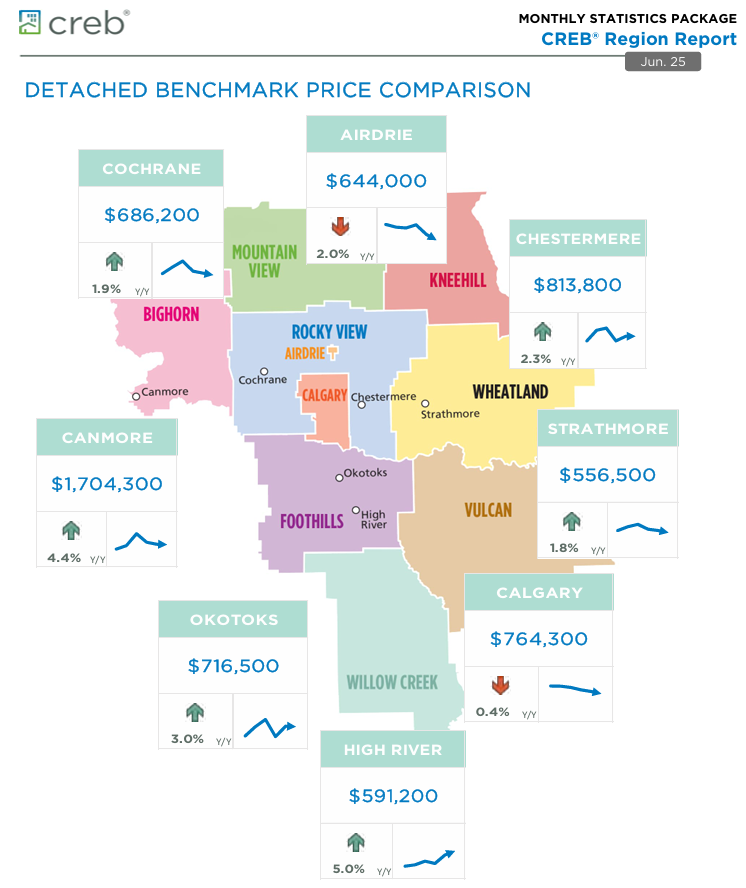
Thanks to a sharp decline in detached activity, sales in June fell to 164 units. The pullback in sales was met with 324 new listings, causing the sales-to-new listings ratio to drop to 51 per cent, the lowest ratio reported in June since 2018. The wider spread between sales and new listings drove further inventory gains and for the first time since 2020 the months of supply was above three months. The additional supply choice has weighed on resale prices, which have trended down for the second consecutive month. In June the benchmark price was $538,300, nearly three per cent lower than levels seen last year at this time.
Gains for detached and semi-detached sales were offset by pullbacks for row and apartment units, as June sales remained relatively unchanged over last year. The 101 sales in June were met with 171 new listings and the sales-to-new listings ratio rose to 59 per cent. This slowed the pace of inventory growth, keeping the months of supply just below three months. While conditions are more balanced than they have been, prices in the area continue to rise albeit at a slower pace. As of June, the unadjusted benchmark price was $593,700, nearly one per cent higher than last month and four per cent higher than last June.
While levels are better than last year, both sales and new listings trended down in June, causing the sales-to-new listings ratio to rise to 87 per cent. This prevented any further monthly inventory gains and ensured that the months of supply remained below two months in June. While conditions remain tight in Okotoks, more supply in the broader region has likely prevented stronger price growth in the Town of Okotoks. As of June, the unadjusted benchmark price was $632,800, similar to last month and nearly three per cent higher than last year.
Contact us for a Free Home Evaluation.

Seton remains one of Calgary’s fastest-growing urban districts, offering a vibrant mix of housing, retail, healthcare, and education. In Q2 2025, Seton experienced softening sales and rising inventory — a pattern seen across many SE communities — especially within the apartment market.
Total Sales: 52 units (▼17% YoY)
New Listings: 117 (▼2% YoY)
Total Inventory: 91 units (↑42% YoY)
Benchmark Residential Price (June): $377,467 (▼3.2% YoY)
Months of Supply: 2.63 (↑71% YoY)
Sales: 49 units (↓15%)
New Listings: 111 (↓2%)
Benchmark Price: $377,467 (↓3.2% YoY)
Market Trend: Seton’s apartment-heavy market is cooling. High supply and affordability continue to attract first-time buyers and investors, but price pressures remain downward due to oversupply.
Sales: 3 units (low sample size)
Benchmark Price: Not statistically reliable due to volume
Trend: Limited product available in this category, but ongoing development may expand townhome offerings by 2026.
Not applicable for Q2 2025 – no recorded benchmark or sales activity for these property types in Seton. Most detached homes in the area are still under development or pre-construction.
While specific DOM values are not individually broken out in the dataset, Seton’s months of supply rose 71% to 2.63 months, indicating longer time on market. Buyers have more selection and leverage, particularly in the apartment segment, where competition among sellers is increasing.
Seton is positioned as an education and health hub in Calgary’s southeast. Nearby and serving Seton residents:
Joane Cardinal-Schubert High School (CBE) – Full high school program; modern facility.
All Saints High School (Catholic) – Located nearby in Legacy.
Elementary and middle school students are served by neighboring communities such as Auburn Bay, Mahogany, and Cranston until future Seton schools are completed.
📌 Future School Sites: Designated locations for new K–9 schools have been approved in Seton’s long-term plan to accommodate future growth.
Mixed-use high-density zoning attracts both residential and commercial investment
New apartment and condo developments continue to expand along Seton Blvd and Market Street
Additional park space and pedestrian linkages under development in 2025
South Health Campus Hospital – Full-service medical care and employment anchor
Seton YMCA – Calgary’s largest recreational facility with swimming pools, fitness center, library, and skating rink
Cineplex VIP Theatre, Superstore, Shoppers Drug Mart, banks, clinics, and dining all within walking distance
Apartments remain highly affordable and offer exceptional walkability
Ample inventory and longer DOM provide room to negotiate
Strong rental demand in Seton makes it attractive for investors
Price sensitivity is increasing; units must be competitively priced and marketed
Staging, professional photography, and highlighting Seton’s lifestyle perks are essential to stand out
The oversupply of condos in similar price brackets requires strategic positioning
Q2 2025 marks a cooling phase in Seton’s real estate market, particularly in its apartment sector. While sales declined and inventory grew, Seton continues to hold long-term value due to:
Its position as Calgary’s SE urban center
Access to world-class health, recreation, and retail amenities
Ongoing infrastructure and residential development
Buyers should act carefully but confidently, while sellers will need to align expectations with market realities.
Contact us for a Free Home Evaluation.

Copperfield’s real estate market remained active in Q2 2025, with steady demand across multiple housing types. While sales volumes eased slightly year-over-year, balanced conditions prevailed as new listings rose, giving buyers more selection.
Total Sales: 120 (–9.1% Y/Y)
New Listings: 188 (+11.2% Y/Y)
Sales-to-New Listings (SNL) Ratio: 63.8% (balanced conditions).
Average Inventory: 66 (up 200% Y/Y).
Months of Supply: 1.72 (leaning toward sellers but improving for buyers).
Days on Market: 24 (faster than long-term average).
Overall Benchmark Price: $492,600 (–1.9% Y/Y).
Detached: $624,767 (–0.7% Y/Y).
Semi-Detached: $496,033 (–2.0% Y/Y).
Row/Townhomes: $414,533 (–4.0% Y/Y).
Apartments: $312,467 (–2.7% Y/Y).
Detached homes held values relatively well, while row homes and apartments experienced more pronounced price softening, driven by rising supply.
Detached Homes
Still the most in-demand segment, with 65 sales. Prices held steady, supported by strong family demand and limited long-term supply.
Semi-Detached Homes
Recorded 14 sales. These homes remain a popular mid-tier option, especially for growing families seeking affordability relative to detached houses.
Row/Townhomes
With 30 sales, this segment provides accessible entry points for first-time buyers. Pricing softened, giving buyers more negotiating room.
Apartments
Accounted for 11 sales, reflecting affordability-driven demand. Despite a small dip in pricing, condos remain attractive for investors and younger buyers.
Copperfield is a family-oriented community with convenient access to schools:
Copperfield School (K-5, CBE) located within the community.
St. Isabella School (K-9, Catholic) in nearby communities.
Junior high and high school students are designated to schools in neighbouring New Brighton and Mahogany.
Copperfield is well known for its ponds, pathways, and parks. The community association supports local events and recreation, and the neighbourhood’s access to Deerfoot Trail and Stoney Trail makes commuting convenient. Its balance of affordability and amenities continues to attract families and first-time buyers.
Detached homes expected to remain the strongest segment, supported by family buyers.
Semi-detached and row homes will see steady interest as affordable alternatives.
Apartments may face softer pricing but will continue to appeal to investors and budget-conscious buyers.
Overall, Copperfield should see stable conditions with modest price adjustments as supply levels rise.
Contact us for a Free Home Evaluation.

The New Brighton housing market demonstrated steady buyer activity through Q2 2025, with demand balancing against a healthy increase in new listings.
Sales: 132 transactions (down 13.2% Y/Y).
New Listings: 181 (up 9% Y/Y).
Sales-to-New Listings (SNL) Ratio: 72.9% (favouring sellers slightly).
Inventory: 63 listings on average (up 141% Y/Y).
Months of Supply: 1.43 (indicating a seller-leaning balanced market).
Average Days on Market: 21 (homes selling faster than historical averages).
Overall Benchmark Price: $537,767 (down 1.3% Y/Y).
Detached: $649,967 (–1.2% Y/Y).
Semi-Detached: $547,300 (–2.8% Y/Y).
Row/Townhomes: $420,633 (–0.5% Y/Y).
Apartments: $315,100 (+2.8% Y/Y).
Detached homes dominate the market, while apartments gained traction as affordability pressures grew.
Detached Homes
Represent the majority of sales, with values holding relatively firm. Demand continues from families looking for more space near schools and parks.
Semi-Detached Homes
Pricing softened, reflecting affordability-driven buyer negotiations. Still attractive for families wanting more space than townhomes but at lower costs than detached.
Row/Townhomes
Remained resilient with minimal price decline. With strong absorption, they continue to serve as a popular first-home option.
Apartments
Showed renewed buyer interest, with a 2.8% benchmark increase. Condos are increasingly appealing to first-time buyers and investors seeking entry-level price points.
Families are drawn to New Brighton for its proximity to schools, including:
New Brighton School (K-4, CBE)
St. Marguerite School (K-6, Catholic)
Access to nearby junior high and high schools in Cranston, Auburn Bay, and McKenzie Towne.
South Trail Crossing (130th Avenue SE): Full-service retail corridor with grocery, big-box shopping, dining, and fitness options.
McKenzie Towne High Street: Boutique shops, cafés, and walkable amenities nearby.
New Brighton is a master-planned, family-focused community featuring:
New Brighton Clubhouse: Exclusive resident facility with splash park, skating rink, tennis, and year-round programming.
Pathways & Parks: Ample green spaces, ponds, and playgrounds.
Transit Connectivity: Convenient access to Deerfoot Trail and Stoney Trail for commuting.
Heading into the latter half of 2025, New Brighton is expected to see stable sales and modest price adjustments.
Detached and semi-detached may experience slight downward pressure as supply builds.
Row and apartment segments will likely see continued demand from affordability-driven buyers.
Community amenities, schools, and lifestyle appeal will keep New Brighton highly attractive to families and first-time buyers alike.
Contact us for a Free Home Evaluation.

 独立屋市场亮点分析
 趋势判断
趋势判断

