|
|
|
|
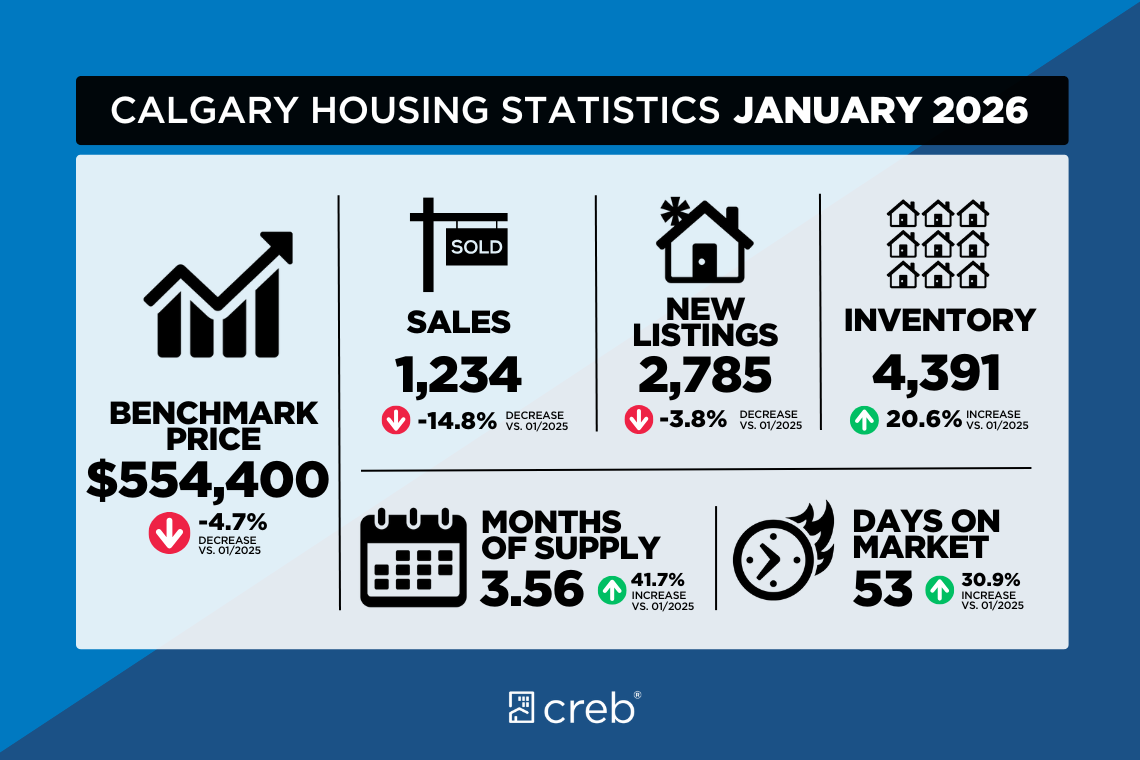
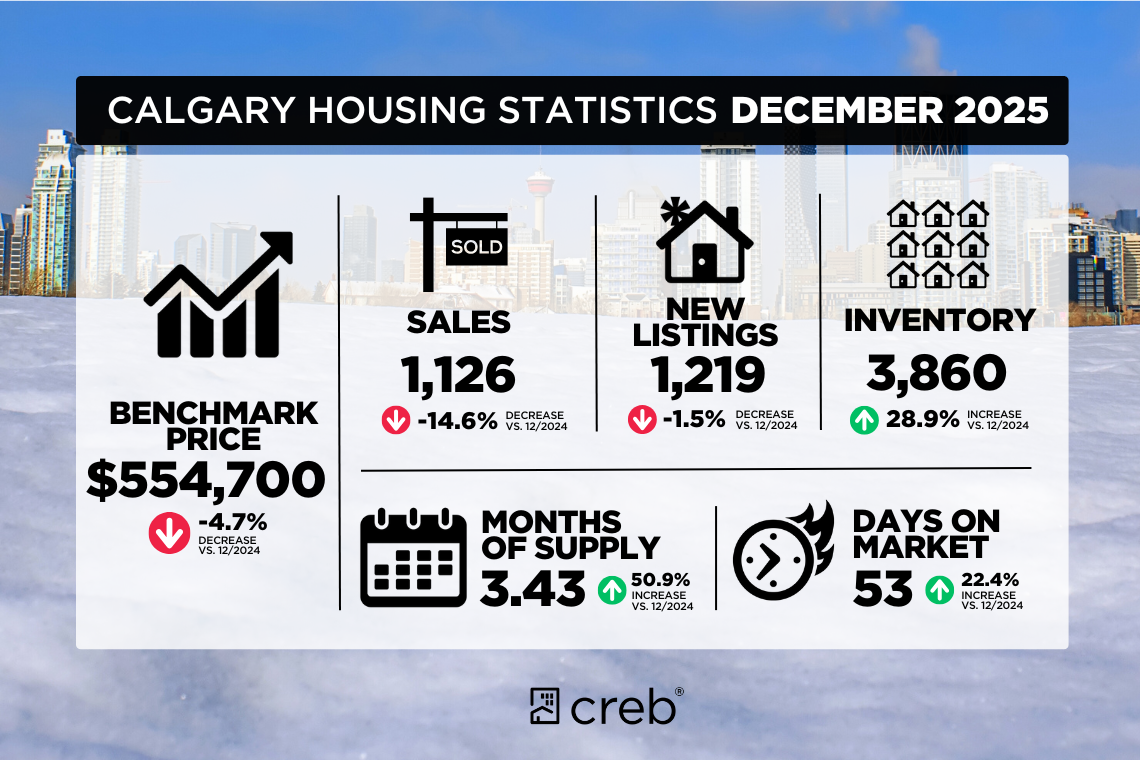
Following several years of strong price growth, 2025 marked a year of transition thanks to strong demand and limited supply. Due to record high starts, supply levels improved across all aspects of the housing market, just as demand pressure eased due to a reduction in migration levels and heightened uncertainty that persisted throughout the spring market. This helped shift the resale market from one that favoured the seller to one that was more balanced.
In 2025, sales reached 22,751 units, down 16 per cent over last year, but in-line with long-term trends. Much of the shift came from the growth in supply. 2025 saw over 40,000 new listings come onto the market, nine per cent higher than last year, causing inventories to rise and driving more balanced conditions.
“Supply levels were expected to rise in 2025. However, the growth was higher than expected especially for apartment condominium and row homes. This weighed on prices in those sectors enough to offset the annual gains reported for both detached and semi-detached homes,” said Ann-Marie Lurie, CREB®’s Chief Economist. "Adjustments in both supply and demand varied across the city, with pockets of the market continuing to experience seller’s market conditions versus some areas where the conditions favoured the buyer. This resulted in different price trends based on location, price range and property type.”
Overall, the annual average total residential benchmark price in 2025 was $577,492, two per cent lower than last year’s annual average. However, annual detached and semi-detached prices rose by a respective one and three per cent, while apartment and row homes saw prices fall by a respective three and two per cent.
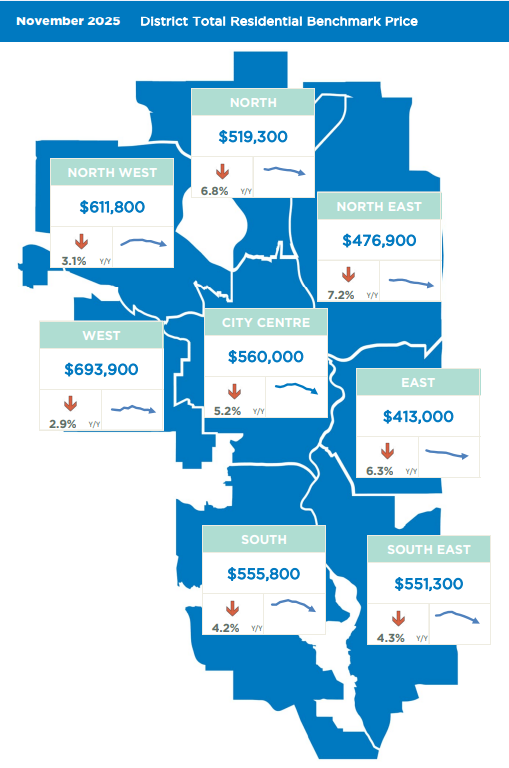
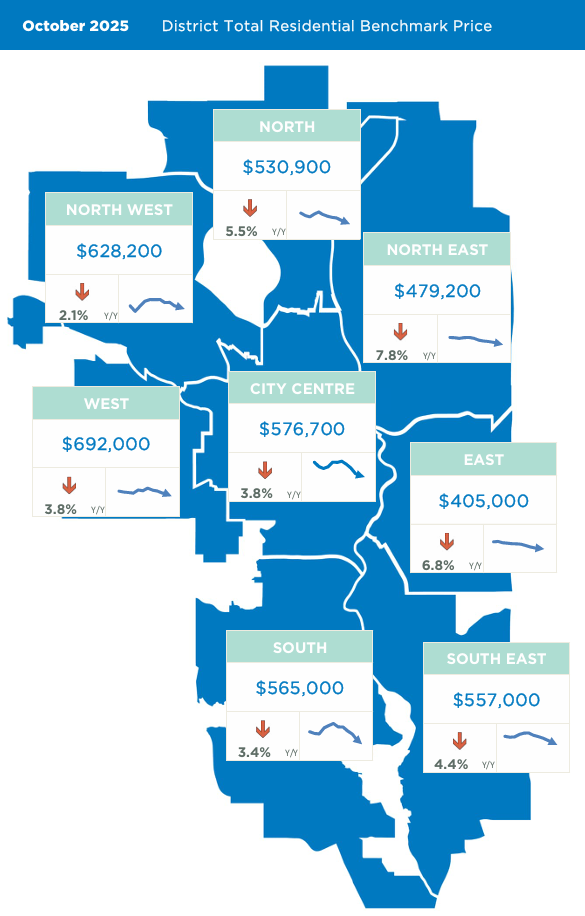
Compared to other districts, the North East reported the largest decline in prices this year. While some of this is related to improved supply across all areas of the city, it is also important to note that the North East district also reported the strongest price growth over the past two years.

Detached sales totaled 11,328 in 2025, down by nearly nine per cent compared to last year. Sales eased across all districts in the city, with the steepest declines occurring in the North East, East and City Centre district. However, unlike the City Centre, the North East and East districts also experienced significant gains in inventory compared to long-term trends, driving annual price declines of two per cent. Meanwhile, in the City Centre detached inventory remained well below long-term averages, which likely prevented stronger sales and contributed to the annual price growth of over three per cent. Despite the differing conditions in different areas of the city, slowing sales and rising supply citywide helped move the market into balanced conditions by the second half of the year. The annual average benchmark price was $752,767, one per cent higher than last year’s annual level.
Semi-detached homes represent the smallest segment of the market, accounting for less than 10 per cent of all sales activity. Sales in 2025 were 2,159, eight per cent lower than last year, but slightly higher than long-term trends. Trends for semi-detached homes have been relatively consistent with the detached market. However, it took longer for this segment of the market to shift to more balanced conditions, resulting in stronger annual price gains. In 2025, the average annual benchmark price was $685,850, nearly three per cent higher than last year. Prices did ease in the North district as competition for new homes weighed on resale activity, but the decline in this district was more than offset by the four per cent gain in the City Centre.
2025 sales eased by 17 per cent to 3,838 units. Despite the decline, sales were still higher than long-term trends, as row homes are starting to account for a larger share of the overall activity in the city. At the same time, new listings also rose relative to sales, driving inventory gains and taking the pressure off prices. Conditions shifted to more balanced levels relatively early in the year, and by the last quarter conditions ranged from a balanced to a buyer’s market depending on the districts of the city. Overall, this contributed to the annual average benchmark price decline of two per cent. While prices were relatively stable in the City Centre, North West, West and East districts, additional supply in the resale market and competition from new homes caused prices to decline by four per cent in the North East and North districts.
Apartment-style homes reported the largest adjustment in price in 2025. Sales declined by 28 per cent compared to the near record high levels achieved last year. While the decline was significant, sales were still over 28 per cent higher than long-term trends. The main cause of the shift in conditions was due to the supply. Over the past three years, there has been a rise in apartment-style starts. While most of the apartment starts were purpose-built rental, they are adding to the supply choice and weighing on the resale market. Resale condominiums saw the market shift in favour of buyers by the second half of the year, with elevated months of supply being reported in most districts of the city. This resulted in relatively persistent downward pressure on prices, causing the annual average benchmark price to decline by nearly three per cent. Price declines were the steepest in the North East nearing five per cent. The only area to report relative stability in the annual price was in the West district.
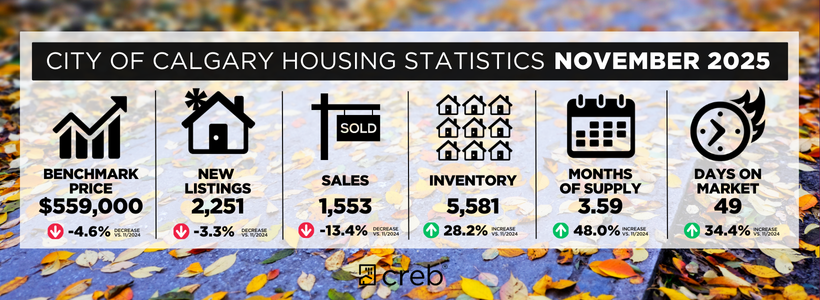
In line with typical seasonal trends, sales, new listings and inventory levels all slowed relative to last month. The 1,553 sales were met with 2,251 new listings, causing the sales-to-new-listings levels ratio to improve to 69 per cent. This also helped support some of the inventory adjustment. However, with 5,581 units in inventory, levels are still 28 per cent higher than last year and over 15 per cent higher than typical levels reported in November.
“Supply levels have been sitting higher than typical levels for the past three months, mostly due to the gains occurring in the higher-density sectors of row and apartment style units,” said Ann-Marie Lurie, CREB®’s Chief Economist. “This is partially related to the additional supply choice coming from the new homes sector, some of which end up on the resale market, especially near the end of the year. While buyer’s market conditions are more prevalent for apartment-style homes and to a lesser extent row homes, outside of a few pockets of the market, both the detached and semi-detached markets are relatively balanced.”
The additional supply choice across resale, new and rental markets, is having the most impact on apartment and row style home prices which are reporting year-over-year price declines of seven and six per cent. In comparison detached home prices are down by two per cent compared to last November, but still higher than last year when looking at year-to-date figures. Overall, the unadjusted total combined residential benchmark* price in November was $559,000, nearly five per cent lower than last year.
*To keep the benchmark price relevant, once a year the attributes of a benchmark home are reviewed and the benchmark prices are updated. The review has been completed and the data has been updated. While all historical adjustments have occurred, old PDF monthly reports are not adjusted.

Detached sales in November were 823 units, just slightly lower than last year’s level, and relatively consistent with activity reported for November. The monthly reduction in new listings helped push down inventory levels compared to last month, but inventory remained well above the lower levels reported last year and are now relatively consistent with long-term trends. Overall, the months of supply remained around three months, reflecting a relatively balanced condition. Despite this we did see unadjusted prices trend down over last month, mostly reflecting seasonal patterns. As of November, the unadjusted detached benchmark price was $733,000, down by nearly two per cent compared to last November. However, when considering the year-to-date figures, prices are still one per cent higher than last year. Most of the downward price adjustments have occurred in the North East, North and East districts as competition from new homes and additional supply choice in other parts of the city are more heavily weighing on those districts.
Sales in November were comparable to levels reported last year and still well above long-term trends, but with new listings also higher than typical levels for this time of year, inventories rose to the highest November level seen over the past five years. While conditions have been generally tighter for this property type, over the past three months we have seen the months of supply remain above three months, resulting in more balanced conditions. While the unadjusted benchmark price of $671,700 did ease over last month, it remained stable compared to last year. Year-to-date price growth has been the strongest in this sector at nearly three per cent, with the largest gains occurring in the City Centre at four per cent, partially offsetting the one per cent pullback in the North district.
November sales eased to 257, however, last year was a record high for the month and current sales remain above long-term trends. Where there continues to be more notable shifts is in supply. New listings remained comparable to last year and inventories, while reporting the typical seasonal decline, were at November levels not seen since 2018. The additional supply has caused the months of supply to remain slightly elevated, especially over the past three months. This has been placing some downward pressure on prices. In November, the unadjusted benchmark price was $424,400, down over last month and over six per cent lower than last year. While some of the monthly decline is seasonal, more persistent price declines have caused the year-to-date price to fall by nearly two per cent.
This sector has struggled the most with excess supply. November sales dropped to levels consistent with long-term trends, but new listings remained elevated and November inventory levels hit a record high for the month. The months of supply edged near six months and has been sitting above four months since the summer. This has resulted in relatively persistent price adjustments throughout the second half of the year and as of November the unadjusted benchmark price was $309,300, seven per cent lower than last year at this time. Year-to-date the decline was just over two per cent, with the largest decline occurring in the North East district at nearly five per cent. The only district to see prices remain flat was the West district.

As per typical seasonal behaviour, sales, new listings and inventory levels all eased over levels reported last month. Overall, both sales and new listings have remained at levels consistent with long-term trends for the month, but thanks to earlier gains inventory levels remain elevated for November. Some of the rise is due to a higher share of newer homes coming onto the resale market. The additional supply over the past several months has weighed on prices in Airdrie. While it has by no means offset the gains reported over the past four years, year-to-date benchmark prices for detached homes are down by nearly one per cent compared to last year.
The seasonal monthly pullback in new listings was not enough to prevent November levels from reaching a record high. While sales also remained relatively strong for November, it was not high enough to cause a more significant monthly pullback in inventories, which have not been this high in November since 2018. Some of the gains in new listings were due to a larger share of new homes being listed on the resale market. While recent gains in supply have caused some adjustments in price, prices continue to remain higher than levels reported last year. Year-to-date detached benchmark prices are nearly two per cent higher than levels reported last year.
Unlike other areas, sales in Okotoks improved compared to last month and were similar to levels reported last year. This in part could be related to the higher level of new listings that were available both in November and October, providing more choice to potential buyers. The Okotoks market has seen some recent gains in inventory levels, but overall supply remains well below long-term trends. Conditions have remained relatively tight in the Okotoks market and, despite some recent adjustments in prices, overall prices are still higher than last year on a year-to-date basis across each property type.
Contact us for a Free Home Evaluation.
Inventory levels eased over last month thanks to the combined impact of a monthly pullback in new listings and a monthly pick up in sales. With 6,471 units in inventory and 1,885 sales the October months of supply returned to three-and-a-half months after pushing up to four months in September. While both row- and apartment-style properties continue to report elevated supply levels compared to demand, conditions remain relatively balanced for both detached and semi-detached properties.
Year-to-date sales in the city totaled 20,082, down nearly 16 per cent compared to last year, but still in line with longer-term trends. Much of the decline in sales has been driven by pullbacks for apartment- and row-style homes.
“Improved rental supply and easing rents have slowed ownership demand for apartment- and row-style homes. It is also these segments of the market that have seen October inventories reach a record high for the month,” said Ann-Marie Lurie, CREB®’s Chief Economist. “Excess supply for apartment- and row-style properties is weighing on prices in those segments more so than any other property type, influencing total residential prices.”
As of October, the total unadjusted residential benchmark price in Calgary was $568,000, down nearly one per cent compared to last month and over four per cent lower than last year’s levels. The largest price adjustments occurred for row- and apartment-style properties where prices have eased by a respective six and seven per cent compared to last October.

October sales reached 1,012 units, an improvement over last month, but still five per cent lower than last year’s levels. At the same time there were 1,593 new listings that came onto the market, causing the sales-to-new-listings ratio to rise to 64 per cent and inventories to trend down over last month to 2,913. Inventory levels remain slightly higher than long-term trends for the month, but with just under three months of supply, conditions remain relatively balanced and far better than conditions reported during the 2015 to 2019 period.
Despite relatively balanced conditions, there are pockets of the market that are experiencing buyer’s market conditions, which is impacting prices. Citywide detached benchmark prices eased to $744,400 in October, one per cent lower than last year. However, price adjustments ranged from a year-over-year gain of nearly two per cent in the City Centre to a decline of over five per cent in the North East district. Despite recent adjustments, year-to-date prices remain over one per cent higher than last year.
Sales improved over last month while new listings slowed, causing the sales-to-new-listing ratio to rise to 57 per cent, which is slightly lower than typical levels for this time of year, but high enough to prevent any significant change in inventory levels compared to last month. With 186 sales and 613 units in inventory, the months of supply was over three months, higher than last year’s extremely low levels, but lower than last month.
More inventory choice has weighed on prices over the past several months. However, with an October benchmark price of $683,100, prices remain nearly one per cent higher than last year and on a year-to-date basis are over three per cent higher than last year.
With 275 sales in October, year-to-date row sales totaled 3,412 units, a 17 per cent decline over last year. While row sales remain well above long-term trends, new listings have been on the rise and reached record highs so far this year. As of October, there were 1,054 units in inventory, the highest ever reported for the month and nearly 32 per cent higher than long-term averages. This also caused the months of supply to remain around four months.
The additional supply choice has weighed on prices. The October benchmark price was $431,200, over one per cent lower than last month and nearly six per cent lower than prices reported last year at this time. The steady slide in row prices have caused year-to-date prices to drop by one-and-a-half per cent. Price adjustments did vary across the city with the largest year-to-date declines occurring in the North East and North districts.
The pullback in new listings relative to sales this month did help prevent further gains in inventory levels. However, with 1,891 units in inventory and 412 sales, the months of supply remained elevated at nearly five months. Apartment condominiums have been experiencing buyer’s market conditions for nearly 6 months, placing downward pressure on prices. As of October, the benchmark price was $318,200, down over one per cent compared to last month, and nearly seven per cent lower than last October.
On a year-to-date basis, prices are nearly two per cent lower than last year’s levels. The largest year-to-date price declines occurred in the North East and South East districts at four per cent, as those districts are either reporting the highest months of supply on the resale market or are facing significant competition from the new home market.

Activity slowed as we moved into October. While sales have remained consistent with longer-term trends, new listings reached a record high for October, keeping inventories elevated. With 535 units in inventory and 136 sales, the months of supply remained over four months. The persistently higher months of supply over the past four months, combined with additional supply choice in the new home market, has weighed on resale home prices. Prices in Airdrie have been trending down since April of this year and as of October the benchmark price was $520,400, nearly one per cent lower than last month and nearly five per cent lower than last year’s levels.
Sales in Cochrane improved this month, keeping year-to-date sales at levels that are relatively consistent with last year. At the same time, while levels remained high, new listings did trend down over last month, causing the sales-to-new-listings ratio to rise to 55 per cent and preventing any further gains in inventory levels. The months of supply eased to just over four months in October, higher than the low levels reported over the past several years, but relatively more consistent with long-term trends for the month. As of October, the benchmark price was $585,200, similar to last month and over two per cent higher than last year. Year-to-date prices in the area have risen by nearly four per cent. Some of the gain in prices could be related to a larger share of new homes ending up being sold on the resale market in Cochrane.
October reported 91 new listings on the market, a significant gain over last month and last year’s levels. The rise in new listings was met with slower sales activity, causing the sales-to-new-listings ratio to dip below 50 per cent, supporting a modest gain in inventory levels. While inventory levels are finally improving, they remain low relative to longer-term trends. This has likely prevented a more significant shift in prices in the Okotoks area. In October, the unadjusted benchmark price was $618,600, up over last month but consistent with last October. Year-to-date benchmark prices have improved by over one per cent.
Contact us for a Free Home Evaluation.
|
|
|
|
|
Contact us for FREE HOME EVALUATION.
|
|
Contact us for FREE HOME EVALUATION.
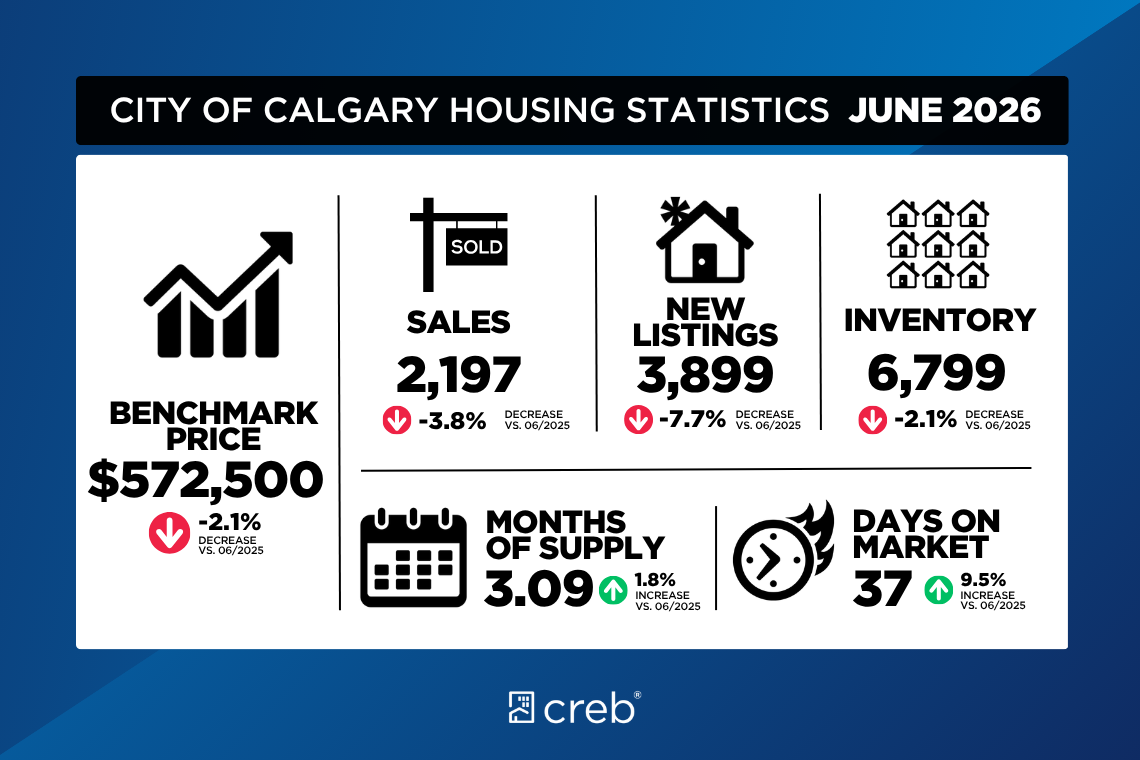
Inventory levels in June continued to rise, both over last month’s and last year’s levels. By the end of the month, inventory reached 6,941 units, returning to levels reported in 2021, or prior to the surge in population growth. While sales have remained consistent with long-term trends despite a decline from recent months, higher levels of new listings compared to sales have contributed to the inventory gain.
All property types have reported gains in inventory, but both row and apartment style homes reported inventory levels over 30 per cent higher than long-term trends, while supply for detached and semi-detached units are only slightly higher than typical levels.
“Supply has improved across rental, resale and new home markets, allowing for more choice for those considering their housing options,” said Ann-Marie Lurie, Chief Economist at CREB®. “The additional choice combined with no further declines in lending rates, persistent uncertainty and concerns of price adjustments is keeping many potential purchasers on the sidelines. This is weighing on home prices, especially for apartment and row style homes.”
The unadjusted benchmark price was $586,200 in June, lower than last month and over three per cent lower than last year. Much of the citywide decline was driven by apartment and row style homes, which are over three per cent lower than last year. Meanwhile, detached prices have remained relatively stable and semi-detached homes are still slightly higher than last year.
The steeper price declines for apartment and row style homes are reflective of those segments shifting toward a market that favours the buyer with nearly four months of supply. Meanwhile conditions are relatively balanced for detached and semi-detached homes. Overall conditions in Calgary have changed, but not enough to erase the significant growth in prices that have occurred over the past four years.

Sales in June were 1,194 units, six per cent lower than both last year and last month's activity. Sales activity did vary depending on location and price range, with declines in resale sales mostly for higher priced homes that likely face more competition from new homes. On a location basis, the steepest declines in sales occurred in the City Centre and the North East at over 20 per cent, while year-over-year gains were reported in the West, and South East districts.
While sales did vary, inventories and new listings improved across most price ranges and districts in the city. However, it is only the North East district that is experiencing conditions that favour the buyer, causing prices to decline by four per cent compared to last June. As of June, the unadjusted benchmark price in Calgary was $764,300, less than one per cent lower than both last month and last year’s price.
Sales activity continued to slow this month, contributing to the year-to-date decline of nearly 12 per cent. At the same time new listings have generally been rising compared to last year, supporting inventory gains and a shift to balanced conditions. As of June, the months of supply was 2.6 months, a significant improvement over the tight conditions reported last year.
Additional supply choice has slowed the pace of price growth for semi-detached homes. As of June, the benchmark price in the city was $696,400, similar to last month, and over one per cent higher than last June. Price movements did range by district, as homes in the City Centre are over three per cent higher than last year and at record high levels, while prices in the North, North East, and East districts are all over two per cent lower than last year and three per cent lower than last year’s peak price.
New listings continue to rise relative to the number of sales in the market, as the sales-to-new listings ratio in June dropped to 50 percent. This contributed to further inventory gains with 1,167 units available at the end of the month. While sales are still higher than long-term trends, the recent gains in inventory levels have caused the months of supply to push above three months. Within the city, conditions range with nearly six months of supply in the North East and two and a half months of supply in the North West.
Higher supply levels relative to demand are weighing on prices which, at a June benchmark price of $450,300, are down over last month and three per cent lower than last year’s levels. However, as the level of oversupply does range across the districts, so too do the price movements. The City Centre has seen the most stability in prices this month and is only one per cent below last year’s peak. Meanwhile, the North East is reporting year-over-year price declines of nearly six per cent.
June new listings and sales both eased over last month’s and last year’s levels. However, with 1,024 new listings and 532 sales, inventories continued to rise and the months of supply pushed up to nearly four months. Slower international migration numbers are weighing on housing demand just as supply levels are rising, which is having a larger impact on apartment style homes.
The rising supply choice, both in new and resale markets, has caused resale prices to trend down again this month, leaving June’s benchmark price of $333,500 over three per cent lower than last year’s levels. While prices have eased across all districts in the city, the largest year-over-year declines are occurring in the North East, North and South East districts.

Thanks to a sharp decline in detached activity, sales in June fell to 164 units. The pullback in sales was met with 324 new listings, causing the sales-to-new listings ratio to drop to 51 per cent, the lowest ratio reported in June since 2018. The wider spread between sales and new listings drove further inventory gains and for the first time since 2020 the months of supply was above three months. The additional supply choice has weighed on resale prices, which have trended down for the second consecutive month. In June the benchmark price was $538,300, nearly three per cent lower than levels seen last year at this time.
Gains for detached and semi-detached sales were offset by pullbacks for row and apartment units, as June sales remained relatively unchanged over last year. The 101 sales in June were met with 171 new listings and the sales-to-new listings ratio rose to 59 per cent. This slowed the pace of inventory growth, keeping the months of supply just below three months. While conditions are more balanced than they have been, prices in the area continue to rise albeit at a slower pace. As of June, the unadjusted benchmark price was $593,700, nearly one per cent higher than last month and four per cent higher than last June.
While levels are better than last year, both sales and new listings trended down in June, causing the sales-to-new listings ratio to rise to 87 per cent. This prevented any further monthly inventory gains and ensured that the months of supply remained below two months in June. While conditions remain tight in Okotoks, more supply in the broader region has likely prevented stronger price growth in the Town of Okotoks. As of June, the unadjusted benchmark price was $632,800, similar to last month and nearly three per cent higher than last year.
Contact us for a Free Home Evaluation.
Thanks to steep pullbacks in the apartment condominium sector, total residential sales in Calgary eased by 17 per cent compared to May of last year. While the drop does seem significant, the 2,568 sales this month remain 11 per cent higher than long-term trends for May and improved over last month.
New listings continued to rise this month compared to sales, resulting in further gains in inventory levels. However, the monthly gain in both inventory and sales prevented any significant change in the months of supply compared to April. With 2.6 months of supply, conditions are still relatively balanced.
“Compared to last year, easing sales and rising inventories are consistent trends across many cities, as uncertainty continues to weigh on housing demand. However, prior to the economic uncertainty, Calgary was dealing with seller market conditions, and the recent pullbacks in sales and inventory have helped shift us toward balanced conditions taking the pressure off prices,” said Ann-Marie Lurie, Chief Economist at CREB®. “This is a different situation from some of the other larger cities, where their housing markets were struggling prior to the addition of economic uncertainty.”
Last year there was limited inventory across most property types and price ranges. Recent inventory gains are creating pockets of the market that are struggling with too much supply while in other areas supply levels are still low relative to the demand, resulting in divergent trends in home prices.
Both detached and semi-detached home prices have remained relatively stable this month and are still higher than last year’s levels. Meanwhile, row and apartment style homes have reported modest monthly price declines and May prices remain below last year’s levels, as improved new home and rental supply is weighing on resale prices. Overall, the total residential unadjusted benchmark price in Calgary was $589,900, slightly lower than last month and over two per cent below May 2024 levels.

New listings in May rose to 2,419 units, with most of the gains driven by homes priced over $600,000. At the same time, sales activity has slowed across most price ranges, supporting a shift toward more balanced conditions and relative stability in prices. However, districts that are facing more competition from new home product or are seeing a larger pullback in demand are starting to show some signs of elevated supply.
The North East district has seen the largest pullback in resale sales activity combined with some of the highest gains in new listings. This has driven the sales-to-new listings ratio down to 41 per cent and the months of supply was nearly four months in May. This is causing prices to ease in the North East, offsetting some of the gains reported in the City Centre, West, and North West districts. City-wide the unadjusted benchmark price in May was $769,400, similar to last month, one percent higher than last May, and still above last year’s seasonal peak price.
The 428 new listings in May were met with 256 sales, causing the sales-to-new-listings ratio to rise to 60 per cent this month. This slowed the pace of inventory growth and the months of supply remained just above two months. Semi-detached homes continue to remain less than 10 per cent of all sales and inventory levels in the city.
This in part is due to construction patterns shifting toward more row style properties over semi-detached, and is one of the reasons we do not see the same inventory build as row and apartment style homes.
Like the detached market there is significant variation within the city districts. The North East has the highest months of supply at nearly three months and is reporting some price declines, while the tightest conditions are in the North West, where prices continue to rise. Overall, generally tighter conditions are still supporting price gains for semi-detached properties. In April the unadjusted benchmark price was $697,300, a monthly gain of less than one per cent, nearly three per cent higher than last year’s levels and above last year’s seasonal peak.
Row home sales have eased over last year’s near record high pace but stayed well above long-term trends. However, the gain in new listings has continued to cause further inventory gains. For the second month in a row, inventory levels were over 1,000 units; we have not seen this much inventory for row units since 2021.
While inventory levels have improved across all districts, we are starting to see higher months of supply in the North East district at 3.5 months, resulting in some downward pressure on prices. The North, North West and South areas have also reported higher year-over-year pullbacks in resale prices, as improved supply choice for new properties are impacting resale activity. Overall, the benchmark price in May was $453,600, down over last month, nearly two per cent below last May, and lower than last year’s seasonal high.
Sales this month totaled 579 units, a significant decline over last May’s record high of 907 units. While new listings were lower than levels reported last year, they remained high compared to sales, causing the sales-to-new listings ratio to drop to 47% this month. This contributed to further inventory gains and drove the months of supply up to 3.6 months.
High levels of apartment rental units under construction are adding to the rental supply and contributing to rent adjustments. This is likely slowing condo ownership demand coming from existing renters and potential investors, contributing to some of the shifts witnessed in the apartment condominium sector.
More supply choice is also weighing on condominium prices. In May the benchmark price eased to $335,300, down from last month and over one per cent lower than last year. The steepest declines are occurring in the North East and South East districts, where competition from the new home market is weighing on resale pricing. While prices have eased and are below peak levels, recent declines have not offset the double-digit gains reported over the past two years.

While improving over last month, May sales eased compared to last year, contributing to the year-to-date decline of 10 per cent. However, the 772 sales so far this year are consistent with long-term trends in Airdrie. At the same time new listings continue to rise causing the sales-to-new listings ratio to fall to 58 per cent, still well within balanced conditions, but a significant change from the over 90 per cent ratio reported last year. Recent shifts in sales and new listings have supported gains in inventory levels.
In May there were 468 units in inventory, reflecting the highest May reported since prior to the pandemic. The shift in supply is in part related to the surge in new construction providing more options for potential consumers. Additional supply choice is impacting price growth. The total residential benchmark price was $540,600 in May, down nearly one per cent over last month and nearly two per cent below last year’s levels.
Sales in Cochrane were fairly resilient until this month, where sales were 17 per cent slower than last year. The decline was enough to cause year-to-date sales to ease to levels just below those reported last year. At the same time, this month new listings surged, driving the sales-to-new listings ratio down to 55 per cent and supporting further inventory gains. With 293 units available in May, levels are more consistent with long-term trends. The months of supply neared three months in May and while this did slow the pace of price growth, the total residential benchmark price of $589,400 is still nearly four per cent higher than last May.
A boost in new listings this month supported a surge in sales activity. However, with a sales-to-new-listings ratio of 74%, inventory levels did not change much over last month and the months of supply once again dropped below two months. Okotoks has struggled to add supply at the pace reported in Calgary, Cochrane and Airdrie and sales growth has been dampened by limited supply choice.
While there have been some improvements in inventory levels, as of May levels remained nearly 28 per cent below long-term trends for the city. The limited supply choice given the relatively strong demand has continue to support some price growth in the town. As of May the unadjusted benchmark price was $633,900, up over last month and over two per cent higher than last year.
Click here to view the full City of Calgary monthly stats package.
Click here to view the full Calgary region monthly stats package.
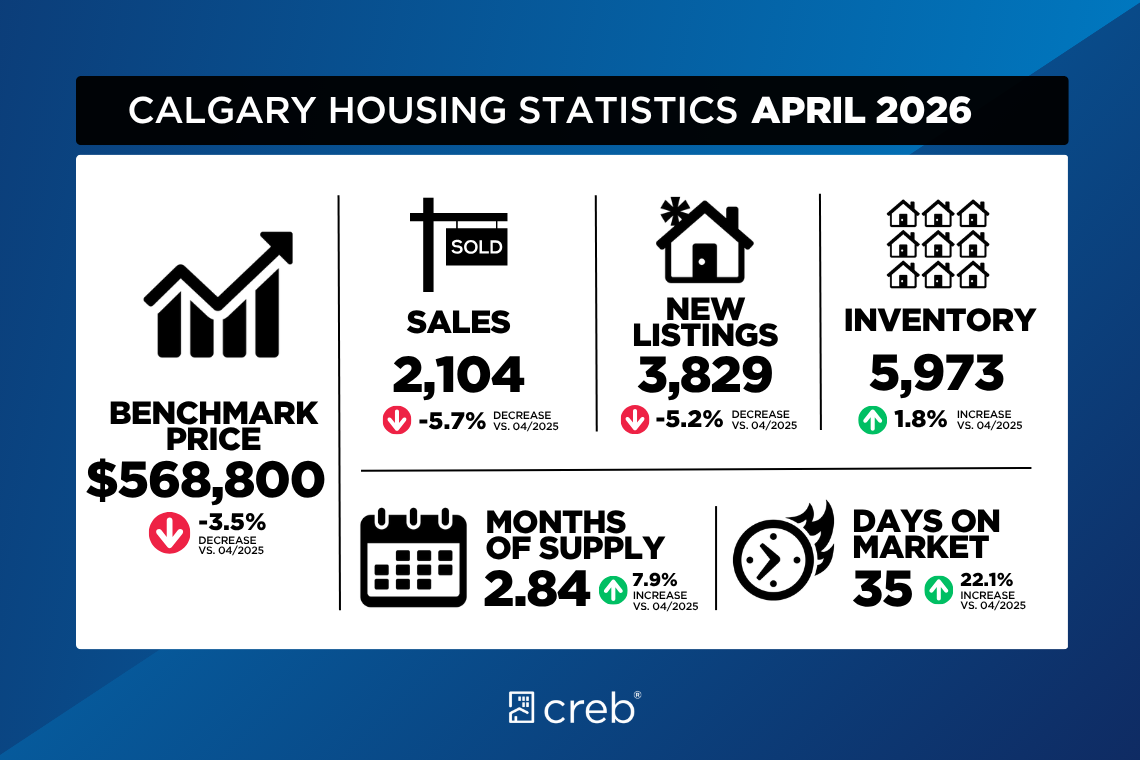
A boost in new listings this month relative to sales caused April inventories to rise to 5,876 units. Although this is more than double the number reported last year, last year’s supply was exceptionally low, and current inventory levels are consistent with what we typically see in April. April sales reached 2,236 units—22 per cent below last year’s levels but in line with long-term trends.
“Economic uncertainty has weighed on home sales in our market, but levels are still outpacing activity reported during the challenging economic climate experienced prior to the pandemic,” said Ann-Marie Lurie, Chief Economist at CREB®. “This, in part, is related to our market's situation before the recent shocks. Previous gains in migration, relatively stable employment levels, lower lending rates, and better supply choice compared to last year’s ultra-low levels have likely prevented a more significant pullback in sales and have kept home prices relatively stable.”
The rise in inventory levels helped the market shift to balanced conditions with nearly three months of supply. However, conditions vary depending on price range and property type. Lower-priced detached and semi-detached properties continue to struggle with insufficient supply, while row and apartment-style homes are seeing more broad-based shifts to balanced conditions.
The additional supply has helped relieve the pressure on home prices following the steep gains reported over the past several years. Benchmark prices for each property type have remained relatively stable compared to last month. However, compared to last year, detached and semi-detached prices are over two per cent higher than last year's levels, while apartment and row-style home prices have remained relatively unchanged.

Detached sales were 1,102 units in April, a year-over-year decline of 16 per cent. While sales eased across most areas of the city, the South East district has seen sales rise over last year's levels. April saw 1,907 new listings come onto the market, and the sales-to-new-listings ratio remained balanced at 58 per cent. Inventories rose to 2,511 units, and the months of supply rose to 2.3 months. While this is a significant gain over the less than one month of supply reported last year at this time, conditions remain relatively tight, especially in the lower price ranges.
In April, the unadjusted benchmark price reached $769,300, similar to last month but over two per cent higher than last April. The added supply choice, combined with uncertainty, has slowed the pace of price growth. However, with a year-over-year gain of nearly five per cent, the City Centre has exhibited stronger price growth than any other district.
Easing sales in April contributed to the year-to-date decline of nearly 16 per cent. The 190 sales in April were met with 350 new listings, and the sales-to-new-listings ratio fell to 54 per cent. This also caused further gains in inventory levels, which reached 484 units. The rise in inventory did help push the market toward balanced conditions with 2.6 months of supply, a significant improvement over the less than one month reported at this time last year.
The shift toward more balanced conditions has slowed the pace of price growth. In April, the unadjusted benchmark price was $691,700, similar to last month and over three per cent higher than last year. The City Centre reported the largest gain, at over five per cent, while prices in the North remained stable compared to last year.
April sales slowed for row homes, contributing to the year-to-date decline of 16 per cent. Meanwhile, new listings continued to rise compared to last year, driving the sales-to-new-listings down to 51 per cent. In April, inventories reached 1,005 units, the highest level reported since 2021, and the months of supply rose to nearly three months. Improved supply has taken some of the pressure off prices,
In April, the unadjusted row price was $457,400, a slight gain over last month, but relatively unchanged compared to April of last year and still below last year's peak price reported in June. The pullbacks reported in the North and North East districts offset year-over-year gains in most districts.
April sales eased by nearly 30 per cent over last year's record high but were far stronger than long-term trends. While sales have remained relatively strong, new listings in April reached a record high for the month, supporting further gains in inventory levels. With three months of supply in the city, conditions are considered relatively balanced. However, activity does range significantly based on location, impacting price movements.
The North East district reported the highest months of supply at seven months, resulting in a year-over-year price decline of two per cent and a spread of over seven per cent from last year's high. Overall, the April benchmark price in the city was $336,000, similar to last year but still three per cent lower than last year's record high.
Contact us for a Free Home Evaluation.
A boost in new listings this month relative to sales caused April inventories to rise to 5,876 units. Although this is more than double the number reported last year, last year’s supply was exceptionally low, and current inventory levels are consistent with what we typically see in April. April sales reached 2,236 units—22 per cent below last year’s levels but in line with long-term trends.
“Economic uncertainty has weighed on home sales in our market, but levels are still outpacing activity reported during the challenging economic climate experienced prior to the pandemic,” said Ann-Marie Lurie, Chief Economist at CREB®. “This, in part, is related to our market's situation before the recent shocks. Previous gains in migration, relatively stable employment levels, lower lending rates, and better supply choice compared to last year’s ultra-low levels have likely prevented a more significant pullback in sales and have kept home prices relatively stable.”
The rise in inventory levels helped the market shift to balanced conditions with nearly three months of supply. However, conditions vary depending on price range and property type. Lower-priced detached and semi-detached properties continue to struggle with insufficient supply, while row and apartment-style homes are seeing more broad-based shifts to balanced conditions.
The additional supply has helped relieve the pressure on home prices following the steep gains reported over the past several years. Benchmark prices for each property type have remained relatively stable compared to last month. However, compared to last year, detached and semi-detached prices are over two per cent higher than last year's levels, while apartment and row-style home prices have remained relatively unchanged.

Detached
Detached sales were 1,102 units in April, a year-over-year decline of 16 per cent. While sales eased across most areas of the city, the South East district has seen sales rise over last year's levels. April saw 1,907 new listings come onto the market, and the sales-to-new-listings ratio remained balanced at 58 per cent. Inventories rose to 2,511 units, and the months of supply rose to 2.3 months. While this is a significant gain over the less than one month of supply reported last year at this time, conditions remain relatively tight, especially in the lower price ranges.
In April, the unadjusted benchmark price reached $769,300, similar to last month but over two per cent higher than last April. The added supply choice, combined with uncertainty, has slowed the pace of price growth. However, with a year-over-year gain of nearly five per cent, the City Centre has exhibited stronger price growth than any other district.
Semi-Detached
Easing sales in April contributed to the year-to-date decline of nearly 16 per cent. The 190 sales in April were met with 350 new listings, and the sales-to-new-listings ratio fell to 54 per cent. This also caused further gains in inventory levels, which reached 484 units. The rise in inventory did help push the market toward balanced conditions with 2.6 months of supply, a significant improvement over the less than one month reported at this time last year.
The shift toward more balanced conditions has slowed the pace of price growth. In April, the unadjusted benchmark price was $691,700, similar to last month and over three per cent higher than last year. The City Centre reported the largest gain, at over five per cent, while prices in the North remained stable compared to last year.
Row
April sales slowed for row homes, contributing to the year-to-date decline of 16 per cent. Meanwhile, new listings continued to rise compared to last year, driving the sales-to-new-listings down to 51 per cent. In April, inventories reached 1,005 units, the highest level reported since 2021, and the months of supply rose to nearly three months. Improved supply has taken some of the pressure off prices,
In April, the unadjusted row price was $457,400, a slight gain over last month, but relatively unchanged compared to April of last year and still below last year's peak price reported in June. The pullbacks reported in the North and North East districts offset year-over-year gains in most districts.
Apartment Condominium
April sales eased by nearly 30 per cent over last year's record high but were far stronger than long-term trends. While sales have remained relatively strong, new listings in April reached a record high for the month, supporting further gains in inventory levels. With three months of supply in the city, conditions are considered relatively balanced. However, activity does range significantly based on location, impacting price movements.
The North East district reported the highest months of supply at seven months, resulting in a year-over-year price decline of two per cent and a spread of over seven per cent from last year's high. Overall, the April benchmark price in the city was $336,000, similar to last year but still three per cent lower than last year's record high.

REGIONAL MARKET FACTS
Airdrie
For the third month in a row, sales activity eased compared to last year's levels. Despite the declines, sales remain above long-term trends. At the same time, new listings continue to rise, but with 185 sales and 290 new listings in April, the sales-to-new listings ratio reached 64 per cent, an improvement over recent months. Inventory levels continued to trend up this month. However, after three consecutive years of exceptionally low April levels, inventory is now consistent with long-term trends. With 2.3 months of supply, conditions are moving to a more balanced state, taking the pressure off home prices. In April, the total residential price was $544,700, relatively unchanged compared to both last month and last year's levels.
Cochrane
For the fourth month in a row, sales activity in the area has remained consistent with last year's levels, resulting in 335 sales so far this year, a nearly five per cent gain over last year and consistent with long-term trends. New listings have also been on the rise, but the sales-to-new-listings ratio has remained at 60 per cent, preventing the doubling of inventory in this market. While inventory levels have improved compared to last year, the 246 units available in April are just shy of long-term trends. Like other areas, improvements in supply have slowed the pace of price growth, but in Cochrane, prices are still edging up. In April, the total residential benchmark price was $592,000, trending up over last month and nearly six per cent higher than prices reported in the previous year and at a record high.
Okotoks
Sales in Okotoks continue to ease compared to last year, contributing to the year-to-date decline of 16 per cent. Over the past few years, sales have been restricted by a lack of supply. However, this year we have started to see a shift. New listings continue to improve in April compared to sales, causing the sales-to-new-listings ratio to ease to 53 per cent, supporting inventory gains. However, with 127 units in inventory in April, levels remain below long-term trends for the month. The modest gains in inventory have slowed the pace of price growth in the area. As of April, the unadjusted benchmark price was $627,100, down slightly from last month, but nearly two per cent higher than last April.
Contact us for a Free Home Evaluation.
For latest community market report, SIGNUP HERE.
In March 2025, the Calgary real estate market for detached homes over $1M dollars remained active, reflecting strong buyer demand across various price segments. The sales volume, price trends, and community-specific insights indicate a dynamic market with variations in pricing and demand across different areas.
The detached home market showed varying trends across different price points:
$1M - $1.5M:
This price range saw a healthy level of activity, with many sales occurring in desirable inner-city and suburban communities.
Buyers in this segment were primarily move-up buyers and investors seeking premium properties in well-established neighborhoods.
Homes in this range generally spent a moderate number of days on the market, with well-priced and upgraded properties selling quickly.
$1.5M - $2M:
Sales in this segment remained strong, particularly in communities offering larger lot sizes and luxury finishes.
High-end buyers were focused on newer builds and extensively renovated properties, reflecting a preference for modern features.
Some properties in this range took slightly longer to sell, particularly those with unique or niche features.
$2M+ Market:
The luxury market continued to attract buyers despite higher interest rates and economic fluctuations.
Many homes in this bracket were custom-built estates in exclusive neighborhoods.
While the volume of sales was lower compared to the mid-tier markets, demand remained steady for high-end properties with premium features.
Several communities stood out in March 2025 due to increased sales activity or notable price trends:
Inner-City Areas (Altadore, Mount Royal, Elbow Park)
Continued to be in demand for their proximity to downtown and high-end amenities.
Buyers sought modern infill homes, leading to competitive pricing and quick sales for well-designed properties.
Homes in these areas generally maintained strong price points, reflecting their desirability.
West Calgary (Aspen Woods, West Springs, Springbank Hill)
Remained popular among families looking for larger homes with modern upgrades.
Sales activity was robust, especially for properties with upgraded interiors and premium lots.
Prices remained stable, with slight increases in high-demand pockets.
Northwest & North Calgary (Evanston, Nolan Hill, Tuscany)
Attracted buyers looking for value and newer homes in family-friendly areas.
Detached homes here were more affordable than inner-city counterparts, making them appealing to first-time and move-up buyers.
Prices remained stable, with strong competition for well-maintained properties.
South & Southeast Calgary (Mahogany, Legacy, Cranston)
High interest in lake communities and newer developments continued.
Detached homes in these areas saw consistent demand, with well-priced properties moving quickly.
Buyers prioritized homes with modern layouts, finished basements, and upgraded kitchens.
Luxury Market (Elbow Valley, Bearspaw, Britannia)
Sales in the ultra-luxury market were more selective, with buyers prioritizing unique architectural styles and large land parcels.
Prices in this segment were stable, though negotiation flexibility was evident for premium properties.
Sales Activity: March 2025 experienced solid sales volumes across most price points, with mid-tier homes ($1M - $1.5M) showing the most activity.
Days on Market: Well-priced and move-in-ready homes sold faster, while higher-priced and niche properties took longer.
Buyer Preferences: Modern finishes, larger lot sizes, and prime locations remained top priorities.
Market Stability: Prices remained strong, with certain high-demand communities seeing slight increases.
As of the end of March 2025, there were 483 active detached home listings in the Calgary market, with the majority priced above $1 million. The overall market remained stable, especially in the luxury segment ($1.5 million and above), which continued to see strong supply and demand.
Contact us for a Free Home Evaluation.
For the latest community market report, SIGNUP HERE.