RSS

最新加拿大经济发展状况 城市排名-前十名

CIBC的最新调查是在不同方面的基础上得出的,排名依次为:
1, Toronto, ON - 20.6
2,Calgary, AB - 19.5
3,Regina, SK - 18.4
4,Winnipeg, MB - 18.4
5,Staskatoon, SK - 18.2
6,Edmonton, AB - 17.8
7,Ottawa, ON - 16.8
8,Vancouver, BC - 14.0
9,Halifax, NS - 13.8
10,Saguenay, QC - 12.2

多伦多拥有加拿大最具活力的经济,但随着房地产市场放缓和政府刺激项目的结束,它也面临着来年一些最大的风险,加拿大帝国商业银行(CIBC)的一份最新报告指出。

该银行的“城市活动指数”显示,卡尔加里的经济活力排名全国第二,其次是里贾纳。

虽然报告对这两个草原省城市的经济表示积极评价,但多伦多将面临“一项重大挑战,那就是维持当前经济动能的能力”,CIBC副首席经济学家本杰明·塔尔(Benjamin Tal)写道。

“房地产市场的放缓、联邦和省级政府许多基础设施刺激项目的结束、制造业增长轨迹预计将放慢以及零售贸易活动的疲软,将共同拖累该市在2013年的整体经济动能,”他补充说。

大多伦多地区约占加拿大经济活动的五分之一,而多伦多市本身就占全国GDP的11%。多伦多的经济放缓不可避免地会对全国其他地区产生负面影响。

CIBC的指数根据九项标准对加拿大主要大都市区进行排名,包括人口和就业增长、个人和企业破产率以及多项住房指标。

尽管多伦多在这些单项指标中没有一项排名第一,但整体得分足够高,因此排名总榜首,该报告指出。

不过,多伦多的房地产行业已出现明显放缓,而该行业占其经济总量的约14%。CIBC数据显示,2012年第三季度,多伦多的住房总销售量同比下降超过10%。

相比之下,住房开工量仍在增长,这让一些观察人士担忧该市的公寓市场可能存在过度建设的风险。

Read

2012年12月卡尔加里房地产市场报告

卡尔加里房地产回归正常

------2012年我们看到了经历四年的房地产微弱市场的尾声

Calgary,一月二日, 2013–卡尔加里的民宅市场在2012年终岁尾以超过2011年15%的交易量收尾,市场基准价上涨5%,卡尔加里的房地产市场终于走出阴霾。房地产市场在2007年达到了近几年的巅峰,之后的几年调整是引领房地产市场向正确的方向发展的必需(市场是不可能总涨不降的)。

市场持续恢复的主动力来源于能源业的增长,伴随着其它行业的改善,包括房地产市场本身。当然了,就业率的提升、移民人口的增加也支撑了房地产市场的改善,并且这一趋势会以缓慢的速度继续支撑2013年房地产行业的发展。

在卡尔加里城市界内,独立屋市场销售增长的步伐远远超过共管公寓市场,与2011年相比,2012年涨幅为15%。新挂牌量并没有齐头并进,而是比2011年降低7%。这也是房屋价格上涨的原因之一,因为市场上流通的可选库存房源明显降低。

买家呢,密切关注市场价值,一见到上市价格符合他们中长期需求的房屋,他们会立即出手买下。价格增长速度短期会放缓,但是绝大部分社区房屋价格仍然会保持在2007年峰值以下。

12月份市场基准价保持在$434,800,比去年同期涨8.7%。总体来说,独立屋市场2012年涨幅为7%,比2007年巅峰值低2%!!!

公寓销售也改善不少,因为不断降低的独立屋库存伴随时刻上调的价格,使得部分买家寻求可替代的房源。2012年的共管公寓、排屋市场成交量分别上涨12%、16%。同时,两个市场的新挂牌量都降低了,使得市场保持均衡水平。不过,两个市场价格增长的步伐却赶不上“风骚”的独立屋市场。

公寓市场12月份基准价为$248,700,比去年同期上涨5.4%。2012年度市场基准均价比去年同期小幅攀升2%,比房地场市场总体均价涨幅5%低了不少。

2012年市场均价的涨幅会误导大家,因为全年有几套百万以上的公寓售出 。 因为不少房屋成交价为于高端,所以均价、中间价比市场基准价稍高一些。


卡尔加里2013年的房地产市场成交量、成交价格均会放缓步伐,但是仍然和全国总体房地产市场往下调整的态势大相径庭。我们的市场并没有和其它城市一个步伐恢复,其实2012年才是卡尔加里二手房市场自2007年巅峰过后的第一次回归到正常市场水平。

预计2013年天然气行业会持续低迷,而石油行业又相当敏感,在这种大气候下,期待房地产市场大涨,好像不太现实。

Read

第四季度 Springbank Hill 成交汇总

Springbank Hill Real Estate Report     Oct.~ Dec. 27

人们还真喜欢西山的这些设区,第四季度光地皮就卖了四处,最便宜的小地块售价27.1万,门朝北的WALKOUT远山景观地皮售价刚过50万。

公寓售出5套,一室公寓带地下停车位售价为$232,500。4套两室两卫带地下停车位的成交均价为$276,375。

 独立屋售价最低的是一套2000年建成的1603平方尺、地下室没装修的前置双车位房屋,售价47.5万,是个好deal。24 套售出房屋均价为$782,975,这给了大家一个大概的印象Springbank Hill 房屋均价在哪个价位段。之后不同房屋售价的区别原因就多了去了,像平面设计布局合理与否、室内装修风格、地下室装修与否、面积大小等等。其中4套房屋售价高于100万,两套是平房。

更多卡尔加里房地产资讯,请查看链接。

Read

Major Canadian Cities Sales Volume and Prices 2007-2012

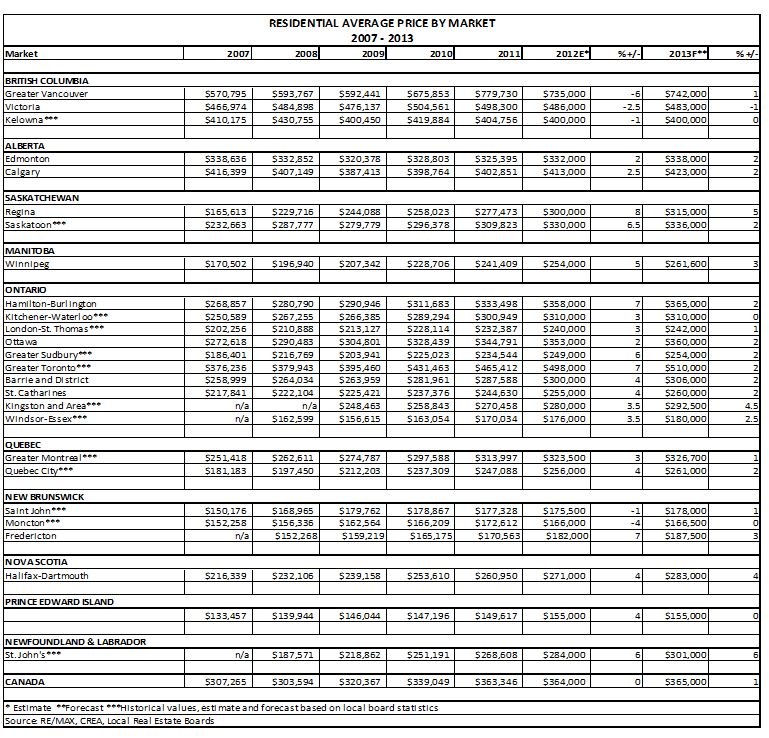
Canadian real estate markets demonstrated remarkable resilience in 2012—with home sales up or on par in 65 per cent of major centres—despite considerable headwinds in terms of tighter financing and economic uncertainty abroad. The trend is expected to continue, with home-buying activity propped-up by low interest rates and an improved economic picture in 2013, according to a report released today by RE/MAX.

The RE/MAX Housing Market Outlook 2013 examined trends and developments in 26 major markets across the country. The report found that the number of homes sold is expected to match or exceed 2011 levels in 65 per cent of markets (17/26) in 2012, led by strong activity in Western Canada, including Calgary (up 13.5 per cent) and Regina (eight per cent). Eighty-one per cent (21/26) of markets are set to experience average price increases by year-end 2012, with Regina the country’s frontrunner at eight per cent, followed by Hamilton-Burlington, Greater Toronto, and Fredericton at seven per cent and Saskatoon at 6.5 per cent. The forecast for 2013 shows the upward trend moderating, but values still ahead of 2012 levels in 85 per cent (22/26) of centres. Stability is forecast to characterize Canadian real estate in the new year, with sales above or on par with 2012 levels in 81 per cent (21/26) of markets.

Nationally, an estimated 454,000 homes will change hands in 2012, falling one per cent short of the 2011 level of 456,749. Canadian home sales are expected to almost mirror the 2012 performance next year, holding steady at 454,000 units. The average price of a Canadian home is expected to remain stable at $364,000 in 2012—on par with the figure reported in 2011. Values are expected to appreciate nominally in 2013, rising to $366,500, one per cent above year-end 2012 levels.

“Looking forward, there are a number of factors on the horizon that will serve to bolster residential activity in 2013,” says Elton Ash, Regional Executive Vice President, RE/MAX of Western Canada. “Canada’s economic performance is expected to show signs of improvement, particularly in the latter half of the year, which should bode well for housing markets across the country. Historically low interest rates will also continue to drive healthy home-buying activity, especially in the move-up segment. Last, but certainly not least, there’s no denying the universal appeal of bricks and mortar. Canadians believe in homeownership. The stability of real estate over the long-term continues to fuel its appeal.”

The report found that low interest rates were a major impetus in 2012, fuelling sales of homes across the board. Tight inventory levels also factored into the equation early in the year, causing a flurry of activity in many centres. By mid-year, however, the third round of CMHC mortgage tightening had a noticeable impact on housing markets, pushing homeownership beyond the grasp of many first-time buyers.

The RE/MAX Housing Market Outlook Report also identified several regional disparities. Most notable was the pull back in sales activity in Greater Vancouver. A banner 2011 year and a slowdown in investor activity contributed to the trend in 2012. Yet, moderation was more widespread in the east, with half of Ontario and Atlantic Canada markets (8/16) reporting 2012 sales off the 2011 pace. Strength was evident throughout Saskatchewan, Alberta, and Nova Scotia, where exceptionally sound economic fundamentals drove demand. The Prairies also stood out in price appreciation, along with the Atlantic Provinces in 2012, and a repeat is on tap for next year. In 2013, Vancouver will rebound to post the strongest sales gain, while the Quebec markets post the sharpest decrease.

“Despite all the negativity surrounding residential real estate, the sky is not falling,” says Gurinder Sandhu, Executive Vice President and Regional Director, RE/MAX Ontario-Atlantic Canada. “Home sales have moderated, but remain within healthy levels. Greater optimism is expected to return next year, as the economy marks further improvement. Canadians appear to be reigning in their spending, heeding cautionary statements by the country’s financial leaders. We believe that will only serve to shore up the already healthy framework of the Canadian housing market in 2013.”

While first-time buyers will continue to have a significant presence in the overall marketplace, they are expected to take a back seat in 2013 in Canada’s largest markets—with move-up buyers the new engine driving home-buying activity. The greatest advance in home sales is expected in Vancouver (12 per cent), Calgary (10 per cent), Halifax (five per cent), Kingston (4.5 per cent) and Saint John (four per cent). The strongest upward momentum in average price in 2013 is forecast for St. John’s (six per cent), Regina (five per cent), Kingston (4.5 per cent), and Halifax (four per cent), followed by Fredericton and Winnipeg at three per cent. More balanced market conditions are expected in 2013 throughout the majority of markets, with supply meeting demand.

“The long-term outlook for Canadian real estate remains strong,” says Sylvain Dansereau, Executive Vice President, RE/MAX Quebec. “It has proven so in the past, and it will ring true in the years to come. Canada’s major centres are evolving at a tremendous pace and gaining traction on the world stage. As we look forward, our communities will certainly be more vibrant, more sustainable, while our housing mix focuses on density and diversification. The sheer number of developments planned or underway is staggering. We know the market ebbs and flows—that’s cyclical—but the future for real estate remains quite promising.”

Immigration and population growth will continue to support housing demand moving forward. The Canadian government’s commitment to immigration will hold steady, with the country set to welcome as many as 265,000 immigrants in 2013. The greater focus on economic immigrants is already leading to quicker household formation and homeownership than in years past. These two factors will also support the burgeoning condominium segment—along with Canada’s aging population—while the desire for tangible assets props up the upper-end.

Read

Nexen 收购获批:加拿大政府批准该公司收购Nexen的交易

中国海洋石油有限公司(CNOOC Ltd. ADS, CEO, 简称:中国海洋石油)周六证实,加拿大政府批准了该公司以151亿美元收购Nexen Inc (NXY)的交易。

这样,中国海洋石油就为完成此项收购交易扫除了一个主要障碍。这项交易将成为中资企业规模最大的海外收购交易,也是迄今为止海外国有企业进军北美能源行业最令人瞩目的一笔收购交易。

中海油董事长王宜林在公告中表示,中海油收购Nexen的提议获得了加拿大工业部的批准,公司对此十分高兴。加拿大工业部认可了中海油收购Nexen的提议将给卡尔加里、阿尔伯达乃至整个加拿大带来长期经济利益。

中海油将把其北美和中美业务的总部设在卡尔加里。该公司还将保留Nexen现有的管理团队和员工。

公告称,中海油还将投入可观资金,作为促进加拿大石油和天然气资源开发的一个长期承诺。

香港--中国海洋石油有限公司(CNOOC Ltd. ADS, CEO, 简称:中国海洋石油)周六证实,加拿大政府批准了该公司以151亿美元收购Nexen Inc (NXY)的交易。

至此,中国海洋石油为完成此项收购交易扫除了一个主要障碍。这项交易将成为中资企业规模最大的海外收购交易,也是迄今为止海外国有企业进军北美能源行业最令人瞩目的一笔收购交易。

中海油董事长王宜林在公告中表示,公司对加拿大工业部批准此项收购提议感到高兴。中海油收购Nexen的交易将给卡尔加里、阿尔伯达乃至整个加拿大带来长期经济利益。

中海油将把其北美和中美业务的总部设在卡尔加里。该公司还将保留Nexen现有的管理团队和员工。

公告称,中海油还将投入可观资金,作为促进加拿大石油和天然气资源开发的一个长期承诺。

更多卡尔加里房地产资讯,请查看链接。

Read

2012年11月份卡尔加里房地产市场走势

卡尔加里二手房市场保持平衡态势
---挂牌房源持续降低,但是继续增长的售出房源使得市场保持均衡发展

Calgary, 十二月三日, 2012 – 从年初至今,民宅销售增长了15%,比去年同期涨8%. 

销售连续8个月两位数字增长,使得市场上的在售房源降低,也源于新挂牌房源量没有相对跟上。然而,售出/流通房源比率显示房地产市场保持均衡发展态势。

由于市场上流通房源量不足,买家特别急切看到新挂牌房源,同时买家对于认同房屋价值的房屋出手迅速。尽管如此,我们并没有看到像以往市场过热时期的疯狂状态。现在的买家更加精明了,他们谨慎权衡各种方案,同时也再三自问:这套房子我家能住多少年?因为他们意识到短线房价大涨好像不太可能。

从年初至今的15%的涨幅使得市场更趋于长线发展水平。历经11个月,新挂牌量已经降至6%,流通房源17%的降幅。每个月的新挂牌房源量始终很低,导致市场基准价从年初至今涨幅5%。

独立屋市场本月售出1,006套,比去年同期涨5%。一般来说,冬季成交量、新挂牌、市场流通房源量都处于较低水平。目前库存流通房源降至2,586套,成交量也低于十月水平,使得市场保持均衡。同时独立屋市场基准价保持$433,600,和十月份一样,比去年同期涨8.5%。

历经11个月,共管公寓市场、排屋市场与2011年相比销售涨幅分别为11%及17%。共管公寓市场2012年总体来说保持均衡发展态势,历经2011年不停往低调整后,现在终于有了小幅价格增长。

11月份共管公寓市场基准价为$248,000,排屋为$282,800,涨幅均为4%。从年初至今涨幅分别为2%及3%。

尽管全国对于消费者负债率、其它经济发展的担忧不断提高,但是卡尔加里的房地产市场始终不肯息事宁人。这主要源于本市移民人口不断提高,薪资、就业率不断提升有关。

价格增长比预期的还要高,尤其是独立屋市场。但是买家还是敏感的,要么他们得把钱花到周边配套设施齐全的设区房子上,要么干脆退一步去公寓市场买套先说。

卡尔加里的房地产市场是改善不少,但是并没有到了接下来要么会大涨、要么会大跌的境地。就业率的缓慢增长、信贷政策的调整、以及石油行业发展动向的挑战都可能放缓需求、抑制大涨,又加上新挂牌量的降低、买家需求的调整,都促使房地场市场保持均衡发展。

更多卡尔加里房地产资讯,请查看链接。

Read

Calgary leads Alberta home prices

Josh Skapin
Calgary Herald

In all forms of the Battle of Alberta, I fully admit to being a biased Calgarian. Whether it be the sports rivalry or nuances like who has better restaurants or more polite drivers, I’ll turn to the Stampede City 10 times out of 10.

So, it wasn’t a head-scratcher when I saw recent Canada Mortgage and Housing Corp. statistics point to a higher average price for single-family homes in Calgary than in our northern counterpart.
What’s worth noting is the widening gap between Alberta’s two biggest cities. In 2009, a few years into the economic downturn, the price difference seemed like pennies.

In fact, if a newcomer to Alberta was on the fence about which city to pick, the cost of a new home likely wouldn’t have made the difference. CMHC says the average price of a single-family home in the Calgary census metropolitan area in 2009 was $547,769. In the Edmonton Census Metropolitan Area, it was $543,243.

Census Metropolitan Area counts neighbouring communities such as Airdrie for Calgary and Sherwood Park for Edmonton.

One year later, the two sides take a bigger step in the opposite direction – where Calgary’s average cost of a single-family home hits $514,466, three hours up the Queen Elizabeth 2 Highway, it tumbles to $490,128. That trend continues and is even more pronounced with CMHC’s estimated closing averages for the two cities in 2012 and 2013 respectively.

If things continue the way CMHC expects, the average cost of a single-family home in Calgary this year will finish at $570,000, while Edmonton’s will be $516,000. CMHC estimates 2013’s prices will be $583,000 in Calgary and only $525,000 in Edmonton. That’s a difference of almost 12 per cent.
CMHC economist Lai Sing Louie says there are a few explanations for the divide. One of the measures CMHC looks at is the new house price index released through Statistics Canada, which tracks the same size of house surrounded by similar amenities in two different periods. That index shows the price of a home in Edmonton is 90.8 per cent of the price it was in 2007, prior to when the economy soured. Calgary is 97.7 per cent of its 2007 price.

“It’s significantly higher,” says Louie. “Calgary has come back more so than Edmonton has since the economic downturn.”

Calgary buyers are also reaching deeper into their pockets for homes than people living in Edmonton. Louie says, despite flat price growth, he’s seen a shift in Calgary buyers putting pen to paper on higher priced homes than people living in Edmonton, adding “that shifted the average higher in Calgary relative to Edmonton.”

“Calgarians like to move-up buy,” says Louie. “If you look around, there are lots of more expensive homes being bought by people in Calgary.” As an example, Louie says just look to the trend in the inner-city where builders are knocking down older homes to put up more modern houses surrounded by central amenities. “That’s happening throughout the inner-city,” he adds.

Economic analyst for the Canadian Home Builders’ Association- Alberta Richard Goatcher says you’ll typically see a higher price tag in Calgary because “incomes are higher and buyers can, on average, carry more mortgage debt and therefore can pay more.” Goatcher suggests land supply may also be an influence.

“In Edmonton, the market is fairly balanced with a good supply in all quadrants,” he says. “Calgary, I believe, has a less-generous supply of new single-detached lots which maybe put more upward pressure on price.”

Read

Canada's economic growth slows to crawl in Q3 at 0.6 per cent: Statscan

OTTAWA — Canada’s economy has hit stall speed with few areas of strong support, setting back any talk of interest rates hikes in the new year and likely restarting calls for more government stimulus.

The economy slumped to 0.6 per cent in the third quarter — below even the gloomy 0.8 consensus and about one third what the Bank of Canada had predicted as recently as the summer — as trouble loomed on the export side, housing and business investment.

In addition, Statistics Canada revised downward the second quarter one notch to 1.7 per cent and September, the last month, was flat, meaning the handoff to the current fourth quarter was weak.
If anything, the details of the report were even bleaker than the bottom-line numbers, given that inventory build-up added to growth, and that consumers — already saddled with record debt levels — contributed 3.8 percentage points.

“Certainly we are seeing strong headwinds. There’s not many cylinders firing at all except for the consumer and we don’t know how long the consumer can continue to carry the load,” said Peter Buchanan, a senior economist with CIBC.

Desjardins Capital Markets economist Jimmy Jean noted that without the inventory build-up of as yet unshipped goods, Canada’s third quarter economy would have fallen into a hole.

There was no talk yet of a technical recession — defined as two consecutive three-month periods of contraction — but Jean said the outlook for the last quarter of 2012 are not good. Given the weak handoff from September, he said the economy would need to work hard to eke out a one per cent advance.

The big shock in the third quarter report was that business investment, which the central bank has been counting on to support the economy, fell two per cent per cent annualized, and residential construction dived 4.4 per cent.

Economists lay the steep housing drop on Finance Minister Jim Flaherty’s decision to tighten mortgage rules on July 9, which has taken the steam out of Canada’s previously hot real estate market.

Jean said he believes the decision was still the correct one, although the economy is paying a price now.

“Yes it is affecting the economy and it’s creating a drag, but on a long-term perspective it’s still the better outcome than facing a pure housing market crash and not having done anything about it,” he said.

Economists said the economy’s performance takes any chance of interest rate hikes off the table, likely until 2014.

The federal government is likely to come under pressure to bump up spending, or at least slow down its austerity program, but that is also unlikely barring a far worse outcome in the fourth quarter or early part of 2013.

In a letter to opposition MPs issued Thursday, the finance minister said he was in no mood to receive suggestions that he should increase spending or raise taxes.

“I will continue to stand against costly, new spending initiatives that would increase the size of government and throw Canada off track for balanced budgets,” he said.

The minister was in Victoria on Friday for a round of pre-budget consultations and will almost certainly be asked whether his position has softened.

As expected, net trade also weighed heavily on the economy in the third quarter as exports plunged 7.8 per cent on weak global demand and soft commodity prices.

Read

Solid economic growth forecast for Alberta into 2013

CALGARY — Alberta’s economy continues to lead the pack across a range of indicators and solid growth will persist in 2013, supported by robust oilsands investment, says Scotiabank’s Global Forecast.

The bank is forecasting the province will lead Canadian economic growth with 3.4 per cent this year followed by 3.0 per cent in 2013.

Employment growth of 3.1 per cent this year and 1.7 per cent in 2013 will also be the best in the country, according to the report.

Warren Jestin, senior vice-president and chief economist with Scotiabank, is in Calgary this week presenting his outlook on the economy.

On Tuesday, Jestin will be discussing the economy at an economic outlook put on by the Calgary Chamber of Commerce. Then on Wednesday, he will be making a presentation on the economy at the annual Calgary Real Estate Forum.

“Well certainly there should be more smiles in Alberta than almost any other place in the country,” said Jestin on Monday.

“Much of that is driven by the ongoing infrastructural projects. We’ve now got demographics that are very, very favourable here.”

“Infrastructural investments remain strong and in fact I think Alberta’s growth may well be supply constrained. You just don’t have the skills or the infrastructure in order to push it ahead as fas as it otherwise would be. For this year, next year and probably into 2014 the odds are very, very strong that Alberta will lead the pack by a very substantial margin.”

Despite some global issues, economic growth in places like China, is good news for Alberta and “amazingly supportive for the commodities sector,” added Jestin.

While Alberta’s economy continues to be a shining light, concerns remain about the global situation which continues to underperform, said the Scotiabank report.

“First, recessionary conditions in the eurozone persist, reinforced by intensifying fiscal austerity and rising unemployment. Weakness is becoming more evident in the larger economies ... Second, U.S. business activity is being undermined by the intensifying problems around the world ... Third, the sharper-than-expected slowdowns in the faster-growing emerging economies of China, India and Brazil have yet to bottom out,” said the report.

“And fourth, even countries with better underlying fundamentals such as Canada, Australia, South Korea, and many of the core members of the eurozone, are being side-swiped by the fallout from reduced global demand.”

Meanwhile, the Conference Board of Canada said Monday that Canada’s domestic economy has softened and its major trade partners are too weak to pick up the slack, limiting growth in GDP to less than two per cent this year.

Canada’s real GDP growth will slow to 1.8 per cent this year, while growth of 2.3 per cent is forecast in 2013, said the board’s Canadian Outlook, Autumn 2012. If a further European sovereign debt crisis can be avoided, or at least contained — and if the U.S. begins to address its fiscal deficit seriously – Canada’s economy is expected to achieve growth of 2.6 per cent in 2014, it said.

“The influence of a grim global environment, coupled with a heavy dose of fiscal restraint, will result in Canada’s economy muddling along through the rest of this year and into 2013,” said Pedro Antunes, Director, National and Provincial Forecast.

“The swift post-recession rebound that occurred in 2010 and 2011, driven by a strong domestic economy, has mostly expired through the first half of this year. Recurring crises stemming from the eurozone, along with some false starts from the U.S. economy, have eroded consumer confidence and slowed business investment and job creation.”

                                                                                                                                                                     by Scotiabank

Read

中海油收购NEXEN 的最新进展

2012年11月20日消息,寻求151亿美元收购Nexen计划获批准的中海油,已接受加拿大政府提出的管理和雇佣方面的条件。

加拿大政府谈判人员接受了很多阿尔伯塔省省长雷德福(Alison Redford)上月所提要求,包括承诺至少50%的Nexen董事会席位和管理职位由加拿大人占据。一位消息人士称,仍有一些商业问题正在协商中,如资本支出要求的范围和中海油国有企业地位相关的一些其它事宜。

Nexen股价上周飙升7%,为中海油7月提出收购要约以来最大周度涨幅,这显示投资者对协议获得加拿大政府批准愈发乐观。

加拿大国家银行金融集团石油和天然气分析师Kyle Preston称,加拿大总理和联邦内阁部长近期的声明提供了积极的暗示,即中海油收购Nexen的交易很快将被批准,马来西亚国有能源公司收购Progress的计划也如此。

Preston接受电话采访时称:“我认为交易接近获得批准。政府正在考虑中海油和Nexen、Progress和Petronas两个收购交易,我认为看上去政府将同时做出两个决定,并列出新交易框架的内容。

更多卡尔加里房地产资讯,请查看链接。

Read
Data is supplied by Pillar 9™ MLS® System. Pillar 9™ is the owner of the copyright in its MLS®System. Data is deemed reliable but is not guaranteed accurate by Pillar 9™.
The trademarks MLS®, Multiple Listing Service® and the associated logos are owned by The Canadian Real Estate Association (CREA) and identify the quality of services provided by real estate professionals who are members of CREA. Used under license.